Source: The Miami Herald 05/08/2007
TALLAHASSEE
They were average people who watched the news occasionally, too busy with family and work to pay attention to their representatives in Tallahassee.
Then tragedy intervened: A son hanged himself with his backpack strap; a daughter was abducted, raped and buried alive; an undetected eye disease sent a toddler to his grave.
Soon they became advocates, the suitless oddities of the state Capitol, working harder than the well-heeled lobbyists to try to get their legislation passed. After years of driving, telling their stories and begging, they bridged the disconnection between Tallahassee and the real people of Florida, learning more about the Legislature than they ever wanted to know.
''I was always raised to believe in the legal system and in justice,'' said Debbie Johnston, a Cape Coral woman whose son, Jeff, hanged himself in a closet two years ago at age 15 after relentless bullying in school and on the Internet. ``I guess I had a very idealized view of government.''
For two years, she has sought legislation to create a statewide ban on bullying. As the session ended nearly eight hours before deadline Friday and her bill died, she wept in the public gallery above while senators congratulated themselves and their staff for the session's hard work.
Last year, the legislation died as representatives debated whether Key lime pie should be the state's official dessert. She still won't eat it.
REGULAR AT HEARINGS
Johnston, who once thought the lawmaking session lasted all year rather than 60 days, quickly became a regular at committee hearings and in the labyrinthine halls of the Capitol. Last year, her first session, she packed Jeff's friends into a bus, rented two hotel rooms and put it on her credit card. They stared up at the 22-story Capitol building, she said, like ``the Clampetts go to Beverly Hills.''
''I used to ride horses, and they can't see the jump before they come to it,'' she added. ``They say throw your heart over the fence and go for it. I just closed my eyes, gritted my teeth and put $4,000 on my credit card.''
Now she rattles off the names of legislative leadership. Speaker Rubio. President Pruitt. She calls her bill sponsor, Rep. Nick Thompson, a Fort Myers Republican, by his first name. She says she will be back in the special session on property taxes in June, and if that fails, next year.
''We're not quitting,'' she said.
Her tenacity is common for this special class of lobbyists, but not all have had to return year after year.
When Jessica Lunsford was killed in 2005 by her neighbor, sex offender John Couey, it sent her father, Mark, of Homosassa on a crusade to toughen state laws to include electronic monitoring and minimum sentences for child molesters. That was accomplished in one legislative session -- the girl's body was discovered in March 2005, and the bill was signed two months later.
Mark Lunsford wore a tie with 9-year-old Jessica's picture on it as Gov. Jeb Bush signed the legislation into law. Lunsford called the tie his ''hug'' from Jessica.
''Every time I asked for something, from the beginning to now, people did it and they did it quickly,'' he told The St. Petersburg Times after the signing.
Not so for Pam Bergsma, a Lake Worth woman whose grandson didn't have a basic eye test that she says would have saved his life. He died in 2000 at age 3 from a rare cancer that wouldn't have been life-threatening if it had been caught earlier. She has been fighting to pass legislation requiring the eye test for retinoblastoma since the 2002 legislative session -- five years ago.
Bergsma, who can't count the number of times she has been to Tallahassee, used to sleep in her car but now stays in a Motel 6, the cheapest place she can find.
''What I have experienced and what I have seen up there, I never would have believed,'' Bergsma said. ``I always had an open mind.''
She has seen senators fight for her bill and against lobbyists for pediatricians, who don't want the requirement. But she says the lawmakers should feel ''shame'' for lengthening her quest, which she swears she will see to the end.
Every year, she truly believes the bill will pass. After no one sponsored it last year because it had failed so many times before, she believed the support she got this session meant it was time. But the bill died again.
''I was so sure'' it would pass this time, she said, then couldn't speak for sobbing.
MUCH TO LEARN
Jodi Walsh, a newcomer to the process who was ''appalled'' at how lawmakers dealt with her when she first visited them in January, said she took action after her ex-boyfriend encouraged her then-6-year-old son to steal a knife from the kitchen and stab her.
She recorded the conversation, and the boy's father was convicted of child abuse, but the decision was overturned because the judge said the legal definition of child abuse didn't include verbal manipulation. So, this session, she tried to convince lawmakers to include mental abuse in the law.
Her bill failed, too, but Walsh says she has learned a lot about the Legislature, which she used to follow only in the newspapers. She believes citizens should hound their representatives throughout the session to remind them of who really holds the power.
''It's personality that comes into play and not principle or priority or issues,'' Walsh said. ``It's their own personalities at each other's throats. That's what it boils down to. That really sickens me.''
Tuesday, May 08, 2007


Monday, May 07, 2007
G.W. Bush Welcomes Queen Elizabeth II

"Our two nations hold fundamental values in common. We honor our traditions and our shared history. We recognize that the strongest societies respect the rights and dignity of the individual. We understand and accept the burdens of global leadership. And we have built our special relationship on the surest foundations -- our deep and abiding love of liberty."
-- President George W. BushMay 7, 2007
Sunday, May 06, 2007
Criticism of the Christian Church
.jpg)
"Loving the Person Who Isn't "One of Us"
By: Rubel
ShellyThe best way for the church to get clear about our mission in the world is to study the life of Jesus. Our goal is to be in our corporate life the continuation of who Jesus was in his personal life. So naturally we take our cues from him. We watch him break down barriers by taking time for children, affirming the dignity of women, and receiving the people others avoid. He touches lepers and blind people. He receives Gentiles and makes a Samaritan the hero of one of his best-known parables. He rescues a woman about to be stoned for committing adultery. He eats with tax collectors and sinners. As you read those stories from the Gospels, however, you notice that the religious establishment is outraged by his behavior. They don't imitate him. They criticize him -- and eventually murder him!It distresses me greatly that churches generally have the same bad name with the general public today that I have just given the "religious establishment" of Jesus' time. That is, churches are typically viewed more as exclusive clubs than welcoming havens. More people say they find nonjudgmental acceptance in Alcoholics Anonymous than in churches! And if you are inclined to reply in a defensive mode that groups like A.A. are willing to tolerate every point of view and let people get by with doing anything the like, you are exposing the fact that you know nothing about how that group functions."
comments welcome
Political Lesson for Chrisitians

"Closing one door, opening another A lesson in politics for conservative Christians
Source: Orlando Sentinel 05/03/2007
Source: Orlando Sentinel 05/03/2007
Kennedy, who is 76 years old and recovering from a heart attack he suffered in December, is one of the best educated and most compelling of all the cultural conservatives who sought to use the political process to reverse the "moral slide" in America. Most of Kennedy's televised messages in recent years have strayed from traditional preaching and focused primarily on politics and social issues.
Brian Fisher, executive vice president of Coral Ridge Ministries, told the Miami Herald, "We believe that by streamlining the operations we will be able to return to our core focus." One hopes that will be preaching the unadulterated Gospel of Jesus Christ, unencumbered by the allures of the political kingdoms of this world, because that is where the greatest power lies to transform lives and ultimately nations. It does not lie in the Republican Party, with which Kennedy's organization was almost exclusively associated.
Politics is about compromise. The message of the church is about truth. One has to look no further than the Al Sharptons and Jesse Jacksons -- who long ago gave up speaking of another kingdom and another King (if they ever did) in favor of faith in the Democratic Party -- to see how quickly the church and its primary message can be blurred when it enters into a shotgun marriage with politics. Jim Naugle, the mayor of Fort Lauderdale, told the Herald that the last election persuaded candidates to package themselves "in the middle, rather than to the right."
Nearly 30 years after religious conservatives decided to re-enter the political arena -- after abandoning it as "dirty" and leading to compromise -- what do they have to show for it? The country remains sharply divided and the reconciling message they used to preach has been obscured by the crass pursuit of the golden ring of political power. In the end, they got neither the power, nor the kingdom; only the glory and even that is now fading, as these older leaders pass from the scene.
This is not to say there is no role for conservative Christians in the civic life of their nation. There is. But Christians must first understand that the issues they most care about -- abortion, same-sex marriage and cultural rot -- are not caused by bad politics, but are matters of the heart and soul. Some evangelicals wish to broaden the political agenda beyond these issues to poverty, social justice and the environment. Politics can never completely cure the ills of any of these, but the message Christians bring about salvation and redemption can. Besides, they can never "convert" people to their point of view.
Too many conservative Christians have focused on the "seen" rather than the "unseen," thinking appearances at the White House, or on Meet the Press, is evidence that they are making a difference. And too much attention has been paid to individual personalities, rather than to the one these preachers had originally been called to exalt.
Nothing in the Bible commands believers to reform or redeem society through government and politics alone, or even mainly. Neither is there any expectation that non-Christians will be converted to the Christian point of view, which can vary on some topics, through politics.
Corwin Smidt, executive director of the Henry Institute for the Study of Christianity and Politics at Calvin College in Grand Rapids, Mich., told the Herald that evangelical groups that are built around a single charismatic leader often struggle when the leader is gone. "These televangelists are able to generate a fair amount of money," he said, "but in terms of their institutional longevity, it's really at risk."
To paraphrase a verse familiar to most Christians, what shall it profit a man if he gains the White House, but loses his own soul?
Christians are also fond of saying God never closes one door without opening another door. The "door" of the Center for Reclaiming America has closed. The new doors can produce a more effective politics, if what's on the other side is based on a message that has less to do with partisanship and more to do with the one who transcends all politics and who lends His power only to those who will use it as He instructed.
Economic indicator: GM profits down 90%

Economic indicator: GM profits down 90%. U.S. business leaders must apply a common sense. Why has Toyota surpassed GM? Because their cars are more reliable, cheaper, and more fuel-efficient. Personally having owned a Honda, Toyota and several GM cars I know this as a fact. Toyota was the best car I have ever had. In addition, Toyota is already producing hybrid cars while GM is not forecasting turning out any significant number of hybrids for years down the road. The drive for corporate profits in the short run may cripple specific companies in the long run. I believe the price of gas is also having an effect on the market for larger (SUV’s).
"Toyota surpassed GM in car sales in the first quarter of 2007, even as both companies posted record sales numbers. That's the first time that's happened, and it gives Toyota a legitimate claim on the title "World's Largest Automaker." GM has held that title for more than 75 years.
Toyota said it sold 2,348,000 vehicles, which is about 88,000 more than GM. If Toyota maintains its lead throughout the rest of the year, GM will lose its place as the world's No. 1 automaker, a position it has held for more than 75 years.
"Well obviously, it wasn't the news we wanted to hear," said John McDonald, a GM spokesman. "But both GM and Toyota are growing around the world, and GM also had a record first-quarter sales performance in the global market."
McDonald said GM has been doing well lately in emerging markets, especially in China, where it now sells a million cars a year.
It's still not clear whether Toyota will end the year with an edge in total sales, but many analysts expect that it will.
Auto analyst Mary Ann Keller said Toyota is growing faster than GM in much of the world, especially in the highly profitable North American market. Keller said Toyota has made so much money that it's been able to open new plants all over the world, from San Antonio to St. Petersburg, Russia.
Toyota's rapid expansion has its downside. Keller said there is evidence that Toyota may be trying to grow too fast and that its vaunted reputation for high quality may not be as strong as it once was.
"Their quality in the United States is not what it used to be," Keller said. "They have suffered enormous numbers of recalls, their warranties costs are up."
But for now, Keller said, there's a good chance that Toyota will end the year as the world's biggest automaker.
For its part, Toyota tried to downplay the milestone today — perhaps because of political sensitivities in the United States. The company said it doesn't pay attention to rankings and is only interested in improving the quality of its vehicles."
BUSH Finally Defines Iraq Success
Americans have been asking a simple question for years. What is meant by success in Iraq?President Bush finally anwers the question.
Source: Agence France Presse 05/02/2007
WASHINGTON, May 2, 2007 (AFP) -
US President George W. Bush on Wednesday was to host top Democrats to wrangle a truce in the bitter feud over the Iraq war one day after he vetoed their effort to tie funding to a withdrawal timeline.
Hours before White House talks also set to include Bush's Republican allies, each side urged the other to compromise amid increasing talk of agreeing to "benchmarks" for the Baghdad government but no sign of a deal on a pull-out.
"I am confident that, with goodwill on both sides, that we can move beyond political statements and agree on a bill that gives our troops the funds and the flexibility they need to do the job," said the president.
Bush, an unpopular leader waging an unpopular war, signalled some of his strongest support yet for clear "benchmarks" for the Baghdad government as he addressed a very friendly crowd at a national builders' meeting here.
"Iraq's leaders still have got a lot to do," he said. "They've got a lot more to do and the United States expects them to do it, just like I expect them to remain courageous and just like they expect us to keep our word."
But he rejected any "precipitous withdrawal" from Iraq, the chief reason he gave Tuesday for vetoing a 124-billion-dollar spending bill for wars in Iraq and Afghanistan that also set October 1 as the start date for withdrawing the 146,000 US troops in Iraq.
The Democratic majority leader in the House of Representatives, Steny Hoyer, said he hoped the chamber would vote on a new Iraq war budget within two weeks, and signalled that the party would not choke off funding for US troops.
"We will not allow this to languish," he said. "We are going to fund the troops, we are not going to leave our troops in harm's way without the resources that they need."
Such a schedule would allow the Senate to take up its own version and send the new emergency bill to fund the wars in Iraq and Afghanistan to Bush at the end of May, he said.
"What we can do is bring about benchmarks for accountability," Democratic Representative Kendrick Meek told CNN television Wednesday. "It's now going on five years. The president wants another blank check."
Bush, in remarks to a builders' association, defended his decision to send more US troops to Iraq this year and pleaded for patience with his approach amid polls showing that both he and the war are deeply unpopular.
"We are heading in the right direction," he said, telling the friendly audience that signs of progress in Iraq were "not headline-grabbing" and "certainly can't compete with a car bomb or a suicide attack."
Republican Senate Minority Leader Mitch McConnell told Fox television that benchmarks for the Iraqis government "is the place where compromise could well be achieved."
"There's bipartisan frustration -- frustration in the Congress with the Iraqi government. I think we can reach an agreement on the kinds of requirements of the Iraqi government that they ought to be pursuing," he said.
He cited the Baghdad government's struggle with passing legislation on oil revenue sharing, setting up local elections, and other matters.
"There are a number of other things they know they need to do in order to continue to enjoy our confidence. And most of it has not yet been done," McConnell warned.
Bush also seemed to fine-tune his definition of victory in the war, saying: "The definition of success as I described is 'sectarian violence down.' Success is not, 'no violence.'"
"There are parts of our own country that have got a certain level of violence to it. But success is a level of violence where the people feel comfortable about living their daily lives," he said.
Bush had most recently defined success as creating a government in Iraq that can "sustain itself, govern itself, and defend itself."
Source: Agence France Presse 05/02/2007
WASHINGTON, May 2, 2007 (AFP) -
US President George W. Bush on Wednesday was to host top Democrats to wrangle a truce in the bitter feud over the Iraq war one day after he vetoed their effort to tie funding to a withdrawal timeline.
Hours before White House talks also set to include Bush's Republican allies, each side urged the other to compromise amid increasing talk of agreeing to "benchmarks" for the Baghdad government but no sign of a deal on a pull-out.
"I am confident that, with goodwill on both sides, that we can move beyond political statements and agree on a bill that gives our troops the funds and the flexibility they need to do the job," said the president.
Bush, an unpopular leader waging an unpopular war, signalled some of his strongest support yet for clear "benchmarks" for the Baghdad government as he addressed a very friendly crowd at a national builders' meeting here.
"Iraq's leaders still have got a lot to do," he said. "They've got a lot more to do and the United States expects them to do it, just like I expect them to remain courageous and just like they expect us to keep our word."
But he rejected any "precipitous withdrawal" from Iraq, the chief reason he gave Tuesday for vetoing a 124-billion-dollar spending bill for wars in Iraq and Afghanistan that also set October 1 as the start date for withdrawing the 146,000 US troops in Iraq.
The Democratic majority leader in the House of Representatives, Steny Hoyer, said he hoped the chamber would vote on a new Iraq war budget within two weeks, and signalled that the party would not choke off funding for US troops.
"We will not allow this to languish," he said. "We are going to fund the troops, we are not going to leave our troops in harm's way without the resources that they need."
Such a schedule would allow the Senate to take up its own version and send the new emergency bill to fund the wars in Iraq and Afghanistan to Bush at the end of May, he said.
"What we can do is bring about benchmarks for accountability," Democratic Representative Kendrick Meek told CNN television Wednesday. "It's now going on five years. The president wants another blank check."
Bush, in remarks to a builders' association, defended his decision to send more US troops to Iraq this year and pleaded for patience with his approach amid polls showing that both he and the war are deeply unpopular.
"We are heading in the right direction," he said, telling the friendly audience that signs of progress in Iraq were "not headline-grabbing" and "certainly can't compete with a car bomb or a suicide attack."
Republican Senate Minority Leader Mitch McConnell told Fox television that benchmarks for the Iraqis government "is the place where compromise could well be achieved."
"There's bipartisan frustration -- frustration in the Congress with the Iraqi government. I think we can reach an agreement on the kinds of requirements of the Iraqi government that they ought to be pursuing," he said.
He cited the Baghdad government's struggle with passing legislation on oil revenue sharing, setting up local elections, and other matters.
"There are a number of other things they know they need to do in order to continue to enjoy our confidence. And most of it has not yet been done," McConnell warned.
Bush also seemed to fine-tune his definition of victory in the war, saying: "The definition of success as I described is 'sectarian violence down.' Success is not, 'no violence.'"
"There are parts of our own country that have got a certain level of violence to it. But success is a level of violence where the people feel comfortable about living their daily lives," he said.
Bush had most recently defined success as creating a government in Iraq that can "sustain itself, govern itself, and defend itself."
FL WRONGLY ACCUSED NOT COMPENSATED
PROCEDURAL TIE-UP IN COMPENSATION BILL MAY LEAVE CLEARED INMATE EMPTY-HANDED
Source: The Miami Herald 05/02/2007
TALLAHASSEE
Alan Crotzer, who is seeking state compensation for the 24 years he spent wrongfully imprisoned, is about to go home penniless this week as he searches for a job and a rational explanation from a state Senate that won't take up his cause.
With just four days to go in the two-month lawmaking session, Senate President Ken Pruitt all but forced his counterparts in the House to kill a measure Tuesday that would have given the St. Petersburg man about $1.25 million for his lost years.
''They call themselves Christians but speak with a forked tongue,'' Crotzer said, referring to Pruitt and the Republican leader of the Senate, Dan Webster.
Pruitt said the ''process'' is to blame, as well as a tight state budget of $72 billion -- which nevertheless has about $1 billion in unspent money.
Pruitt noted the Crotzer measure had stalled in a Senate committee -- in part, because of Pruitt's own rules -- and didn't belong on a separate bill to spend $4.8 million to compensate the family of 14-year-old Martin Lee Anderson, who died after he was violently subdued by Panama City boot camp guards.
Crotzer said he learned how to ''do time'' in prison, but he still reacted angrily to what's happening in the Senate.
Barring a last-minute change, Crotzer, 46, will have to come back to seek state compensation next year. It would mark the third time the former inmate has sought legislation since he was released last year on the strength of DNA evidence showing he didn't commit two rapes.
Many House members were outraged. And Gov. Charlie Crist said ''justice is crying out'' for compensation of both the Anderson family and Crotzer. Nearly all of the 120 House members approved a measure to compensate Crotzer. Then, on Monday, House members tacked Crotzer's language onto the high-profile Anderson relief bill sought by the governor.
But Pruitt insisted the two bills be separated because he and fellow Republican House Speaker Marco Rubio had agreed ahead of time to approve 14 compensation bills, including a measure sought by Rubio to give $8.5 million to former Fort Lauderdale resident Minouche Noel, who was crippled by botched state-paid surgeries when she was an infant 19 years ago.
BACK AND FORTH
In the waning days of the session, when loads of legislation pour on the floor of both chambers, any friction can kill a bill if it has to bounce back and forth between the two chambers as they agree on identical language. The House members then separated Crotzer from the Anderson bill, which passed with just 10 ''no'' votes and heads to the Senate for final approval. The House changed the bill to limit lawyer and lobbyist fees.
''I'm not going to give an opinion on what's fair and not fair,'' Pruitt said. ``The Senate is not going to be put in a position where we're doing it at the last minute. Nothing good ever happens whenever you're rushed or you work late.''
A separate measure compensating Crotzer never made it out of a Senate criminal justice budget committee, whose chairman said he's waiting for Pruitt to bring it to the floor. The Republican leader, Webster, said he prefers the failed bill because it seeks to set up a court-like process that gives all exonerated inmates a flat amount of money based on the number of years wrongfully spent in prison.
Last year, the Legislature awarded $2 million to Wilton Dedge, who spent less time -- 22 years -- wrongfully imprisoned than Crotzer.
The difference between the two: Dedge had a clean record and is white. Crotzer was convicted after stealing beer as a young man and is black.
BUILDING THE FUTURE?
Rep. Terry Fields, a Democratic black caucus leader from Jacksonville, noted that there's about $1 billion in unspent money in the budget and that the Senate wanted to spend half of it on a massive public-works road-paving binge called ``Building Florida's Future.''
''How can you talk about building Florida's future when you don't right the wrongs of the past?'' Fields asked.
Source: The Miami Herald 05/02/2007
TALLAHASSEE
Alan Crotzer, who is seeking state compensation for the 24 years he spent wrongfully imprisoned, is about to go home penniless this week as he searches for a job and a rational explanation from a state Senate that won't take up his cause.
With just four days to go in the two-month lawmaking session, Senate President Ken Pruitt all but forced his counterparts in the House to kill a measure Tuesday that would have given the St. Petersburg man about $1.25 million for his lost years.
''They call themselves Christians but speak with a forked tongue,'' Crotzer said, referring to Pruitt and the Republican leader of the Senate, Dan Webster.
Pruitt said the ''process'' is to blame, as well as a tight state budget of $72 billion -- which nevertheless has about $1 billion in unspent money.
Pruitt noted the Crotzer measure had stalled in a Senate committee -- in part, because of Pruitt's own rules -- and didn't belong on a separate bill to spend $4.8 million to compensate the family of 14-year-old Martin Lee Anderson, who died after he was violently subdued by Panama City boot camp guards.
Crotzer said he learned how to ''do time'' in prison, but he still reacted angrily to what's happening in the Senate.
Barring a last-minute change, Crotzer, 46, will have to come back to seek state compensation next year. It would mark the third time the former inmate has sought legislation since he was released last year on the strength of DNA evidence showing he didn't commit two rapes.
Many House members were outraged. And Gov. Charlie Crist said ''justice is crying out'' for compensation of both the Anderson family and Crotzer. Nearly all of the 120 House members approved a measure to compensate Crotzer. Then, on Monday, House members tacked Crotzer's language onto the high-profile Anderson relief bill sought by the governor.
But Pruitt insisted the two bills be separated because he and fellow Republican House Speaker Marco Rubio had agreed ahead of time to approve 14 compensation bills, including a measure sought by Rubio to give $8.5 million to former Fort Lauderdale resident Minouche Noel, who was crippled by botched state-paid surgeries when she was an infant 19 years ago.
BACK AND FORTH
In the waning days of the session, when loads of legislation pour on the floor of both chambers, any friction can kill a bill if it has to bounce back and forth between the two chambers as they agree on identical language. The House members then separated Crotzer from the Anderson bill, which passed with just 10 ''no'' votes and heads to the Senate for final approval. The House changed the bill to limit lawyer and lobbyist fees.
''I'm not going to give an opinion on what's fair and not fair,'' Pruitt said. ``The Senate is not going to be put in a position where we're doing it at the last minute. Nothing good ever happens whenever you're rushed or you work late.''
A separate measure compensating Crotzer never made it out of a Senate criminal justice budget committee, whose chairman said he's waiting for Pruitt to bring it to the floor. The Republican leader, Webster, said he prefers the failed bill because it seeks to set up a court-like process that gives all exonerated inmates a flat amount of money based on the number of years wrongfully spent in prison.
Last year, the Legislature awarded $2 million to Wilton Dedge, who spent less time -- 22 years -- wrongfully imprisoned than Crotzer.
The difference between the two: Dedge had a clean record and is white. Crotzer was convicted after stealing beer as a young man and is black.
BUILDING THE FUTURE?
Rep. Terry Fields, a Democratic black caucus leader from Jacksonville, noted that there's about $1 billion in unspent money in the budget and that the Senate wanted to spend half of it on a massive public-works road-paving binge called ``Building Florida's Future.''
''How can you talk about building Florida's future when you don't right the wrongs of the past?'' Fields asked.
Law will let you take Fido to the grave
Florida legislators find it more important an issue to debate bills allowing citizens to be buried with their dogs, rather than making legal domestic partnerships. Pets over people. A backward set of priorities in my opinion.
Law will let you take Fido to the grave; Legislators passed a wide-ranging bill on the funeral industry that will give pet owners a new burial option. Source:
The Miami Herald 05/02/2007
TALLAHASSEE
Thanks to a senator's love for his dog, Floridians will soon be able to be buried with the encased ashes of their pets.
A bill in the Legislature that includes wide-ranging provisions on the industry known as ''deathcare'' originally said nothing about dogs and cats. But Sen. Jim King, a Jacksonville Republican, wanted to make sure that he can be buried with the ashes of his favorite black Lab, Valentine, who died about a decade ago.
The Senate voted for the measure 38-1 on Tuesday, sending the bill to the governor.
''Valentine was a very special dog,'' King said, adding that the pet helped him get through the deaths of his parents and was with him in his first campaign for office. ``She was the one living thing that was predictable in my life.''
Besides clearing the way for pet burials, the bill prohibits hospices from owning funeral homes and helps protect funeral directors from lawsuits brought by estranged family members who dispute a cremation. But nothing grabbed more attention than King's ''Felix and Fido'' amendment, which he said has drawn all kinds of comments from constituents.
LOTS OF ATTENTION
''I've got meaningful legislation here that probably never will see the light of day,'' King said, adding that the most praise he's received is for this minor pet amendment.
Sen. Victor Crist, the Tampa Republican and bill sponsor, said he had no problem accommodating King's request.
''The love for your pet is almost as great as the love for the other members of your family,'' Crist said. ``The focus should be on what is important to the deceased.''
Under current law, a licensed cemetery can house only human remains. Burial grounds that have wanted to allow pets usually set aside a plot outside the official cemetery. However, Florida's many unlicensed cemeteries have been allowed to bury pets.
Crist said there's no health issue because the bill allows only remains that have been cremated and encased to lie next to their masters.
A SURGE IN LAWSUITS
The other provisions in the bill are the result of changing societal attitudes on death. Funeral homes have been plagued in recent years by increasingly complex family situations, and cremation is becoming more popular, now accounting for about half of the dispositions in Florida.
The combination has culminated in more lawsuits against funeral homes when they cremate remains based on the wishes of the deceased or family. The bill specifies that funeral homes aren't liable when an estranged family member disputes the decision to cremate.
The hospice provision came out of a scare when a Fort Myers hospice applied for a license to operate a funeral home in December, causing a stir over what many said was a conflict of interest.
The bill passed with just one ''no'' vote. That came from Sen. Steve Oelrich, a Cross Creek Republican, who said he thought the bill placed too many regulations on the industry. To the pet provision, he had no objection.
Actually, he may use it to be buried with his dog, he said: ``Bobby Ray Boykin and I can snuggle up.''
Law will let you take Fido to the grave; Legislators passed a wide-ranging bill on the funeral industry that will give pet owners a new burial option. Source:
The Miami Herald 05/02/2007
TALLAHASSEE
Thanks to a senator's love for his dog, Floridians will soon be able to be buried with the encased ashes of their pets.
A bill in the Legislature that includes wide-ranging provisions on the industry known as ''deathcare'' originally said nothing about dogs and cats. But Sen. Jim King, a Jacksonville Republican, wanted to make sure that he can be buried with the ashes of his favorite black Lab, Valentine, who died about a decade ago.
The Senate voted for the measure 38-1 on Tuesday, sending the bill to the governor.
''Valentine was a very special dog,'' King said, adding that the pet helped him get through the deaths of his parents and was with him in his first campaign for office. ``She was the one living thing that was predictable in my life.''
Besides clearing the way for pet burials, the bill prohibits hospices from owning funeral homes and helps protect funeral directors from lawsuits brought by estranged family members who dispute a cremation. But nothing grabbed more attention than King's ''Felix and Fido'' amendment, which he said has drawn all kinds of comments from constituents.
LOTS OF ATTENTION
''I've got meaningful legislation here that probably never will see the light of day,'' King said, adding that the most praise he's received is for this minor pet amendment.
Sen. Victor Crist, the Tampa Republican and bill sponsor, said he had no problem accommodating King's request.
''The love for your pet is almost as great as the love for the other members of your family,'' Crist said. ``The focus should be on what is important to the deceased.''
Under current law, a licensed cemetery can house only human remains. Burial grounds that have wanted to allow pets usually set aside a plot outside the official cemetery. However, Florida's many unlicensed cemeteries have been allowed to bury pets.
Crist said there's no health issue because the bill allows only remains that have been cremated and encased to lie next to their masters.
A SURGE IN LAWSUITS
The other provisions in the bill are the result of changing societal attitudes on death. Funeral homes have been plagued in recent years by increasingly complex family situations, and cremation is becoming more popular, now accounting for about half of the dispositions in Florida.
The combination has culminated in more lawsuits against funeral homes when they cremate remains based on the wishes of the deceased or family. The bill specifies that funeral homes aren't liable when an estranged family member disputes the decision to cremate.
The hospice provision came out of a scare when a Fort Myers hospice applied for a license to operate a funeral home in December, causing a stir over what many said was a conflict of interest.
The bill passed with just one ''no'' vote. That came from Sen. Steve Oelrich, a Cross Creek Republican, who said he thought the bill placed too many regulations on the industry. To the pet provision, he had no objection.
Actually, he may use it to be buried with his dog, he said: ``Bobby Ray Boykin and I can snuggle up.''
Earth-Like Planet Discovered

"April 25, 2007 · Scientists have discovered a new planet in the constellation Libra. The small, rocky planet is special because it appears to have mild temperatures, like Earth. Researchers believe it looks like the first planet outside of our solar system that could be home to liquid water, and maybe even life.
Our solar system has only eight planets — nine if you count Pluto. But outside of our solar system, around other stars, scientists have found dozens and dozens of planets.
"We have discovered more than 100 planets, here in Geneva," says Michel Mayor, a planet hunter at the University of Geneva.
Almost all of these known "extrasolar" planets are giant balls of gas, much like Jupiter or Saturn. Such massive planets are relatively easy to find. They have a gravitational pull that makes their stars wobble, and when scientists see that wobble, they know there is a planet. Small, rocky planets cause less of a wobble, making them harder to find.
Still, Mayor and his colleagues have had some luck using the European Southern Observatory's big telescope at La Silla, Chile. They recently pointed it at a nearby star called Gliese 581, in the constellation Libra.
"It's one of our closest neighbors in the galaxy," Mayor says.
His team has found three planets around this star, and one of them is particularly interesting. They think the planet is a little bigger than Earth, with about five times the Earth's mass. It orbits very close to its star, going all the way around in just 13 days. The planet isn't super hot though, because Gliese 581 is a red dwarf, which is much dimmer and cooler than our sun.
Scientists calculate that average temperatures on the surface of the planet should be around 32 to 104 degrees Fahrenheit. Mayor says that is a friendly environment for liquid water and maybe even life.
"We do not have any reason to believe that life exists on that planet," Mayor concedes. "We can only say that we have the temperature to permit the development of life. I would say it's one very interesting step in a long process going in the direction to having some major discovery related to life in the universe."
A report on the discovery has been submitted to the journal Astronomy and Astrophysics, and other experts agree that it is a significant find. Alan Boss is a planetary scientist at the Carnegie Institution of Washington.
"This seems to be the first discovery of an Earth-like planet," Boss says. "It's not exactly an Earth but it's close enough that I think it does deserve the title of perhaps the first Earth-like planet."
Other small planets discovered in the past have been very hot, or very cold. In many ways, though, this planet is a mystery.
"We do not know what the composition of the planet is," says Boss, explaining that scientists assume it is made of rock and metal like Earth. "We do not know how much water it may or may not have on it."
Boss says we could learn a lot more if scientists launched a space telescope that is specially designed to look at faraway planets. NASA has one in development called the Terrestrial Planet Finder, but it has been delayed indefinitely by budget woes.
"Things like Terrestrial Planet Finder are no longer really in the active NASA plan," Boss says.
Still, some scientists have a mental picture of the place. Todd Henry, an astronomer at Georgia State University, says that if you were standing on this planet and looked up, its sun would appear to be huge — five times bigger than our sun looks to us.
"It's going to look very different in this sort of alien situation that we're in than what we're used to here on Earth," Henry says. "The star itself is actually going to look sort of the color of Mars — sort of a red, ruddy color. But it would be much bigger in the sky than we're used to."
He says the star is also notable because the Geneva team found those two other planets circling it. They are also relatively small planets, which have been harder to find.
"This is starting to look like a solar system we're familiar with," Henry says. "If you were in a spaceship and you sort of flew into this system, this is one of the most interesting ones there is out there now."
But don't count on visiting anytime soon. Even though Gliese 581 is close, compared with other stars, it still would take over 20 years to get there — if we could travel at the speed of light, which we can't do."
Our solar system has only eight planets — nine if you count Pluto. But outside of our solar system, around other stars, scientists have found dozens and dozens of planets.
"We have discovered more than 100 planets, here in Geneva," says Michel Mayor, a planet hunter at the University of Geneva.
Almost all of these known "extrasolar" planets are giant balls of gas, much like Jupiter or Saturn. Such massive planets are relatively easy to find. They have a gravitational pull that makes their stars wobble, and when scientists see that wobble, they know there is a planet. Small, rocky planets cause less of a wobble, making them harder to find.
Still, Mayor and his colleagues have had some luck using the European Southern Observatory's big telescope at La Silla, Chile. They recently pointed it at a nearby star called Gliese 581, in the constellation Libra.
"It's one of our closest neighbors in the galaxy," Mayor says.
His team has found three planets around this star, and one of them is particularly interesting. They think the planet is a little bigger than Earth, with about five times the Earth's mass. It orbits very close to its star, going all the way around in just 13 days. The planet isn't super hot though, because Gliese 581 is a red dwarf, which is much dimmer and cooler than our sun.
Scientists calculate that average temperatures on the surface of the planet should be around 32 to 104 degrees Fahrenheit. Mayor says that is a friendly environment for liquid water and maybe even life.
"We do not have any reason to believe that life exists on that planet," Mayor concedes. "We can only say that we have the temperature to permit the development of life. I would say it's one very interesting step in a long process going in the direction to having some major discovery related to life in the universe."
A report on the discovery has been submitted to the journal Astronomy and Astrophysics, and other experts agree that it is a significant find. Alan Boss is a planetary scientist at the Carnegie Institution of Washington.
"This seems to be the first discovery of an Earth-like planet," Boss says. "It's not exactly an Earth but it's close enough that I think it does deserve the title of perhaps the first Earth-like planet."
Other small planets discovered in the past have been very hot, or very cold. In many ways, though, this planet is a mystery.
"We do not know what the composition of the planet is," says Boss, explaining that scientists assume it is made of rock and metal like Earth. "We do not know how much water it may or may not have on it."
Boss says we could learn a lot more if scientists launched a space telescope that is specially designed to look at faraway planets. NASA has one in development called the Terrestrial Planet Finder, but it has been delayed indefinitely by budget woes.
"Things like Terrestrial Planet Finder are no longer really in the active NASA plan," Boss says.
Still, some scientists have a mental picture of the place. Todd Henry, an astronomer at Georgia State University, says that if you were standing on this planet and looked up, its sun would appear to be huge — five times bigger than our sun looks to us.
"It's going to look very different in this sort of alien situation that we're in than what we're used to here on Earth," Henry says. "The star itself is actually going to look sort of the color of Mars — sort of a red, ruddy color. But it would be much bigger in the sky than we're used to."
He says the star is also notable because the Geneva team found those two other planets circling it. They are also relatively small planets, which have been harder to find.
"This is starting to look like a solar system we're familiar with," Henry says. "If you were in a spaceship and you sort of flew into this system, this is one of the most interesting ones there is out there now."
But don't count on visiting anytime soon. Even though Gliese 581 is close, compared with other stars, it still would take over 20 years to get there — if we could travel at the speed of light, which we can't do."
The Uninsured
The ability to have access to healthcare should not have any relation to ones economic status as is the current policy in the USA. Neither should barriers for vast changes in America's healthcare system be present. The fact is the U.S.A. spends more in its profit driven healthcare system then it would in a socialized public regulated system. My vote would be in support of the type of healthcare policy seen in Canada and France.
Illness and the uninsured; While politicians are talking, here's a way to raise local money to help
Source: Charlotte Observer (NC) 05/02/2007
From Amsalu Bizuneh, M.D., of Gaston Memorial Hospital:
Joe (not his real name) thought he knew what to do when his groin started to hurt where he had his hernia repaired some two years ago. He came to Gaston Family Health Services, which provides care at reduced fees for those without health insurance. There he was told he had an infection in the material used to repair the hernia deep in his groin.
Joe had relocated to Gastonia from New York after he was laid off from his factory job that provided the health insurance for the initial hernia repair. His new job could not provide the costly health insurance if it hoped to continue to stay open. Joe did not qualify for Medicaid because he made "too much money."
The doctor who saw him at the Gastonia clinic knew what should be done: Joe needed to see a surgeon fast, who could remove the infected material and repair the hernia. Unfortunately, Joe did not have insurance. Further, he did not have the money to pay for the surgeon's consultation fee or for a surgical repair of the infected groin.
Although his doctor at the clinic gave him powerful antibiotics to take by mouth, he knew Joe's condition could worsen, requiring emergency care, an intensive care unit stay and the need to now see several other expert doctors -- all at a much greater cost than outpatient surgery.
Joe is only one of 47 million Americans who lack health insurance today. As we brace for another presidential election cycle, our nation's uninsured have once again become a hot political issue.
Is the political climate finally ripe to reform our complicated health-care system, where many working Americans fall through the cracks?
Maybe. But experience tells us political rhetoric doesn't always lead to effective changes in policy. What is clear, however, is that while candidates may talk about "health-care reform" every four years, those Americans without health-care coverage must roll the dice every single day in the hope that they do not require medical care.
I frequently see patients like Joe, whose conditions have worsened as a result of unavailable outpatient specialty care. Specialists in our community frequently provide charity care to these patients. However, the volume of patients who require this care is beyond the scope of the physicians who volunteer their time and efforts. Many patients earn less than a thousand dollars above the yearly national poverty level and thus are disqualified from Medicaid.
As evidenced by our presidential politics, the dilemma of Gaston County's uninsured is but a microcosm of a growing national problem that cannot wait another four years for a solution.
To this end, I am working with Gaston Family Health Services to raise awareness about uninsured patients requiring specialty care. On June 2, the inaugural Grand Garibaldi Run ( www.grandgaribaldirun.com ) will be held to raise money for those living without health insurance. I hope the 5K race and 1-mile fun walk will bring many people from the Charlotte area to Belmont, 15 minutes west of uptown Charlotte. While we hope our politicians make proposals, form committees and sponsor bills that will finally ensure sweeping health-care reform, it is left to us to take action. I encourage you to participate in the Grand Garibaldi to raise awareness and develop solutions for patients like Joe.
Illness and the uninsured; While politicians are talking, here's a way to raise local money to help
Source: Charlotte Observer (NC) 05/02/2007
From Amsalu Bizuneh, M.D., of Gaston Memorial Hospital:
Joe (not his real name) thought he knew what to do when his groin started to hurt where he had his hernia repaired some two years ago. He came to Gaston Family Health Services, which provides care at reduced fees for those without health insurance. There he was told he had an infection in the material used to repair the hernia deep in his groin.
Joe had relocated to Gastonia from New York after he was laid off from his factory job that provided the health insurance for the initial hernia repair. His new job could not provide the costly health insurance if it hoped to continue to stay open. Joe did not qualify for Medicaid because he made "too much money."
The doctor who saw him at the Gastonia clinic knew what should be done: Joe needed to see a surgeon fast, who could remove the infected material and repair the hernia. Unfortunately, Joe did not have insurance. Further, he did not have the money to pay for the surgeon's consultation fee or for a surgical repair of the infected groin.
Although his doctor at the clinic gave him powerful antibiotics to take by mouth, he knew Joe's condition could worsen, requiring emergency care, an intensive care unit stay and the need to now see several other expert doctors -- all at a much greater cost than outpatient surgery.
Joe is only one of 47 million Americans who lack health insurance today. As we brace for another presidential election cycle, our nation's uninsured have once again become a hot political issue.
Is the political climate finally ripe to reform our complicated health-care system, where many working Americans fall through the cracks?
Maybe. But experience tells us political rhetoric doesn't always lead to effective changes in policy. What is clear, however, is that while candidates may talk about "health-care reform" every four years, those Americans without health-care coverage must roll the dice every single day in the hope that they do not require medical care.
I frequently see patients like Joe, whose conditions have worsened as a result of unavailable outpatient specialty care. Specialists in our community frequently provide charity care to these patients. However, the volume of patients who require this care is beyond the scope of the physicians who volunteer their time and efforts. Many patients earn less than a thousand dollars above the yearly national poverty level and thus are disqualified from Medicaid.
As evidenced by our presidential politics, the dilemma of Gaston County's uninsured is but a microcosm of a growing national problem that cannot wait another four years for a solution.
To this end, I am working with Gaston Family Health Services to raise awareness about uninsured patients requiring specialty care. On June 2, the inaugural Grand Garibaldi Run ( www.grandgaribaldirun.com ) will be held to raise money for those living without health insurance. I hope the 5K race and 1-mile fun walk will bring many people from the Charlotte area to Belmont, 15 minutes west of uptown Charlotte. While we hope our politicians make proposals, form committees and sponsor bills that will finally ensure sweeping health-care reform, it is left to us to take action. I encourage you to participate in the Grand Garibaldi to raise awareness and develop solutions for patients like Joe.
S.Stanton Top of City's List

"Sex change official moves up on city list
By CAROL E. LEE
carol.lee@heraldtribune.com
SARASOTA -- One of the front-runners for Sarasota's city manager position is the former Largo city manager who was fired after commissioners there learned of his plans to have a sex change.Steven Stanton, who applied as Susan Stanton while noting that the name change is not yet official, was one of three applicants that all five Sarasota city commissioners chose Wednesday among their top candidates.
By CAROL E. LEE
carol.lee@heraldtribune.com
SARASOTA -- One of the front-runners for Sarasota's city manager position is the former Largo city manager who was fired after commissioners there learned of his plans to have a sex change.Steven Stanton, who applied as Susan Stanton while noting that the name change is not yet official, was one of three applicants that all five Sarasota city commissioners chose Wednesday among their top candidates.
The commissioners had intended to whittle down the pool of 18 semifinalists to eight, but by the end of a two-hour meeting had settled on 11.A consultant will narrow the 11 down to four to six finalists after conducting background checks and checking references. The commissioners will interview them May 29.The three candidates who won unanimous support from the commission have all served as city managers in Florida.Stanton was Largo city manager for 14 years before he was ousted in March. Patrick Salerno has been the city manager of Sunrise since 1990. Robert Bartolotta was city manager of Jupiter until resigning in 2004 to care for his ailing wife, who has since passed away."I'm interested in getting back into Florida management," Bartolotta said in a telephone interview from Savannah, Ga., on Wednesday. "Service is in my blood."Stanton plans to interview as a woman if he makes the final cut."It would be a dream job," said Stanton, who has visited Sarasota many times during the past few years, as Steven and as Susan."Being part of the community would be such an outstanding ending to what started out as a very unpleasant journey 40-some days ago," Stanton said. Sarasota commissioners' choice "contrasts how one community dealt with diversity and how another is planning to," he said."The fact that the commission has enough faith to look at someone for their credentials speaks miles of the inclusive nature of Sarasota."Salerno could not be reached for comment on Wednesday, but the city's consultant, Tom Freijo of The Mercer Group Inc., told the commissioners that Salerno had expressed interest in the Sarasota job before The Mercer Group started advertising for it.Each commissioner selected his or her top eight candidates from a stack of 18 resumes, while Freijo tallied up their nominations on a 2-foot-by-2-foot Post-It.Another three of the 11 contenders now up for review got the support of four commissioners:Daniel Fitzpatrick has been the city manager of Peekskill, N.Y., for the past four years.Marsha Segal-George has been deputy chief administrative officer of Orlando since June 2006.Michael Wright is assistant city manager for development and transportation in Tallahassee."I would certainly be paying a great deal of attention to them," Freijo said of the candidates with four or five commissioners' support.Five other applicants, who made it on two commissioners' lists, would serve more as backups, he said. They are:James Baker, director of administration for St. Louis County in Missouri.Matt Carlson, city administrator of Delafield, Wis.Dennis Kelly, deputy city manager of North Miami.James Palenick, city manager of Rio Rancho, N.M.Terry Zerkle, president of Local Government Network Inc., a consulting business in Cave Creek, Ariz.Commissioners will make a final selection May 30.
Last modified: May 03. 2007 4:31AM
SARASOTA -- One of the front-runners for Sarasota's city manager position is the former Largo city manager who was fired after commissioners there learned of his plans to have a sex change."
Last modified: May 03. 2007 4:31AM
SARASOTA -- One of the front-runners for Sarasota's city manager position is the former Largo city manager who was fired after commissioners there learned of his plans to have a sex change."
Thursday, May 03, 2007
Wednesday, May 02, 2007
Condoleezza Rice Rise to Power
"Source: All Africa 05/01/2007
May 01, 2007 (Modern Times/All Africa Global Media via COMTEX) --
In the first biography of Condoleezza Rice since her appointment as secretary of state, award-winning Newsweek editor Marcus Mabry explores the contradictions-personal and political-of the most powerful black woman in the history of American politics.
The daughter of a Presbyterian minister and school teacher, Rice was raised in Birmingham, Alabama during the most volatile years of the Civil Rights Movement. She went on to attend the University of Denver, and later Notre Dame, where she received her masters in political science, with an emphasis on the Soviet Union. She later began her academic career at Stanford University, where she held the positions of Assistant and Associate Professor in Political Science, and ultimately became the youngest provost in Stanford's history (as well as the first black and first woman to serve as provost).
Rice began working for the George H.W. Bush administration in 1989, where she served as the Soviet and East European Affairs Advisor. During George W. Bush's 2000 U.S. Presidential election campaign, Rice took a one-year leave of absence from Stanford University to help work as his foreign policy advisor. In 2000 Rice was chosen to be Bush's national security advisor, where she became one of the most vocal proponents of the 2003 invasion of Iraq. In 2004, Rice replaced Colin Powell as (the first female African American) Secretary of State. However along with success comes scrutiny. While Rice's accomplishments have been many, there has also been a great degree of criticism and controversy pertaining to her role as national security advisor and Secretary of State.
Her judgment and actions have been called into question on a number of issues including: supporting the Bush/Cheney agenda by "selling" the war in Iraq to Americans, failing to admit mistakes were made along the way to war (including those of the agency she oversaw), her stand on affirmative action, a seeming distance from America's black community (specifically called into account during the aftermath of Hurricane Katrina) and an initially tepid performance as Secretary of State, followed by a rise to power where she has challenged and (in the case of the nuclear deal with North Korea) surpassed Dick Cheney. Twice as Good skillfully and even-handedly examines both sides of these controversies, with first-hand accounts by Rice and those closest to her that reveal the sources of Rice's strength as well as the origins of her blind spots.
Who is Condoleezza Rice? For all her ceiling-shattering accomplishments and historic rise to prominence and power, Condoleezza Rice remains enigmatic, even sphinx-like, a major player on the American political scene who has somehow escaped the in-depth personal scrutiny characteristic of contemporary politics. In this multilayered portrait, Marcus Mabry penetrates the mysteries surrounding one of the most controversial and fascinating women of our time and explores what price she has paid for her success. While researching this biography, Mabry interviewed her family, friends, and neighbors from her childhood in Birmingham; peers from her years at the University of Denver and Notre Dame; colleagues, allies, and adversaries from Stanford and Washington-and Condoleezza Rice herself. The author, who has had a similar background to his subject-like her, he is African American with roots in the South, a product of Stanford, and a student of international relations-uses this perspective in his interpretation of her life and work, drawing on his personal and professional background as well as his skills as a journalist to uncover a Condoleezza Rice the world has never known. The result is the most comprehensive portrait ever reported of this powerful woman.
MARCUS MABRY, now chief of correspondents at Newsweek, was formerly a State Department and foreign correspondent for the magazine and has written on foreign policy for more than a decade. Mabry has also written extensively on race and class in America, including the memoir White Bucks and Black-eyed Peas: Coming of Age Black in White America.
Twice as Good: Condoleezza Rice and Her Path to Power
By Marcus Mabry "
May 01, 2007 (Modern Times/All Africa Global Media via COMTEX) --
In the first biography of Condoleezza Rice since her appointment as secretary of state, award-winning Newsweek editor Marcus Mabry explores the contradictions-personal and political-of the most powerful black woman in the history of American politics.
The daughter of a Presbyterian minister and school teacher, Rice was raised in Birmingham, Alabama during the most volatile years of the Civil Rights Movement. She went on to attend the University of Denver, and later Notre Dame, where she received her masters in political science, with an emphasis on the Soviet Union. She later began her academic career at Stanford University, where she held the positions of Assistant and Associate Professor in Political Science, and ultimately became the youngest provost in Stanford's history (as well as the first black and first woman to serve as provost).
Rice began working for the George H.W. Bush administration in 1989, where she served as the Soviet and East European Affairs Advisor. During George W. Bush's 2000 U.S. Presidential election campaign, Rice took a one-year leave of absence from Stanford University to help work as his foreign policy advisor. In 2000 Rice was chosen to be Bush's national security advisor, where she became one of the most vocal proponents of the 2003 invasion of Iraq. In 2004, Rice replaced Colin Powell as (the first female African American) Secretary of State. However along with success comes scrutiny. While Rice's accomplishments have been many, there has also been a great degree of criticism and controversy pertaining to her role as national security advisor and Secretary of State.
Her judgment and actions have been called into question on a number of issues including: supporting the Bush/Cheney agenda by "selling" the war in Iraq to Americans, failing to admit mistakes were made along the way to war (including those of the agency she oversaw), her stand on affirmative action, a seeming distance from America's black community (specifically called into account during the aftermath of Hurricane Katrina) and an initially tepid performance as Secretary of State, followed by a rise to power where she has challenged and (in the case of the nuclear deal with North Korea) surpassed Dick Cheney. Twice as Good skillfully and even-handedly examines both sides of these controversies, with first-hand accounts by Rice and those closest to her that reveal the sources of Rice's strength as well as the origins of her blind spots.
Who is Condoleezza Rice? For all her ceiling-shattering accomplishments and historic rise to prominence and power, Condoleezza Rice remains enigmatic, even sphinx-like, a major player on the American political scene who has somehow escaped the in-depth personal scrutiny characteristic of contemporary politics. In this multilayered portrait, Marcus Mabry penetrates the mysteries surrounding one of the most controversial and fascinating women of our time and explores what price she has paid for her success. While researching this biography, Mabry interviewed her family, friends, and neighbors from her childhood in Birmingham; peers from her years at the University of Denver and Notre Dame; colleagues, allies, and adversaries from Stanford and Washington-and Condoleezza Rice herself. The author, who has had a similar background to his subject-like her, he is African American with roots in the South, a product of Stanford, and a student of international relations-uses this perspective in his interpretation of her life and work, drawing on his personal and professional background as well as his skills as a journalist to uncover a Condoleezza Rice the world has never known. The result is the most comprehensive portrait ever reported of this powerful woman.
MARCUS MABRY, now chief of correspondents at Newsweek, was formerly a State Department and foreign correspondent for the magazine and has written on foreign policy for more than a decade. Mabry has also written extensively on race and class in America, including the memoir White Bucks and Black-eyed Peas: Coming of Age Black in White America.
Twice as Good: Condoleezza Rice and Her Path to Power
By Marcus Mabry "
Core Ridge Church Closing Political Arm

Good move. The Church would be better off investing its resources in the works of God, not politicians.
Source: The Miami Herald 05/01/2007
Bringing an end to ambitious goals that included raising $2 million to launch a Capitol Hill lobbying arm, opening a dozen regional offices and recruiting activists in all 435 congressional districts, the Fort Lauderdale-based Center for Reclaiming America has shut its doors.
The conservative organization, part of the Rev. James D. Kennedy's Coral Ridge Ministries, let its eight employees go last week. Coral Ridge also closed its Capitol Hill-based Center for Christian Statesmanship, founded in 1995 to convert lawmakers to evangelical Christianity.
Brian Fisher, executive vice president at Coral Ridge Ministries, said the closings are part of a larger effort to redefine the ministry's mission.
''We believe that by streamlining the operations we will be able to return to our core focus,'' he said.
Fisher said Coral Ridge officials plan to focus on television, radio and Internet, with plans to reach an audience of 30 million by 2012, up from 3 million today.
The closings mark a major shift for Coral Ridge Ministries, which runs the 10,000-member Coral Ridge Presbyterian Church at 5555 N. Federal Hwy. in Fort Lauderdale, television and radio ministries, a seminary and an evangelism training program and has an annual budget of $37 million.
Kennedy, 76, who suffered a heart attack in December, is recovering in a hospital in Michigan.
The change also comes at a pivotal moment for the religious right, which is casting about for a presidential candidate during the most wide-open campaign in more than half a century. The 2006 election delivered a major blow to Republican conservatives in Washington and in Florida, where their favored candidate for governor, Tom Gallagher, was soundly defeated. Earlier that year, a petition drive to put a constitutional ban on same-sex marriage on the ballot fell short, despite the center's efforts.
BACKING WANES
Kennedy, an internationally renowned evangelist, founded the center more than a decade ago to advance conservative Christian values in state and national politics. But in recent years, the center has struggled to gain broad backing for its efforts to outlaw abortion, ban gay marriage and promote prayer and creationism in schools.
Fort Lauderdale Mayor Jim Naugle, who for years has welcomed activists from around the world to the center's annual conference, said politicians seeking to appeal to the center were no longer actively courting Christian conservatives.
''After an election like that, candidates are packaging themselves in the middle, rather than to the right,'' he said. About 1,100 evangelicals -- 300 more than last year -- participated in the center's conference in March.
Naugle said he ''can't help'' but think that the center's closing has something to do with Kennedy's health. ''Certainly he was a driving force and a national recognized leader and, hopefully, his health will allow him to come back strong,'' he said.
Corwin Smidt, executive director of the Henry Institute for the Study of Christianity and Politics at Calvin College in Grand Rapids, Mich., said evangelical groups that are built around a single charismatic leader often struggle in the leader's absence.
NO REPLACEMENT
''For Kennedy, there's just no figure [to replace him] after he's gone,'' he said. ``These televangelists are able to generate a fair amount of money, but in terms of their institutional longevity, it's really at risk.''
He also sees the closings as part of a broader shift away from politics among Christian conservatives.
''There is a kind of retrenching, a regrouping, a rethinking among conservative Christians,'' Smidt said. ``Some people are saying for Christians to be involved in politics, we have to be much more aware of a variety of issues.''
Jennifer Hancock, associate director of the Humanists of Florida Association, said the closings offered evidence that Christian conservatives are losing some of their political clout.
''It's good news for us, and I think its good news for people who care about democracy,'' she said. ``These people were promoting theocracy in America.''
But Gary Cass, who had been the center's executive director for three years, said he plans to stay at the forefront of Christian activism.
''The fight continues because our cause has not changed and the stakes are so high,'' he said.
comments welcome
SUSPECTED MADAM WILL NAME CLIENTS
Source: South Florida Sun-Sentinel 05/01/2007
WASHINGTON
The woman who faces charges of running a prostitution ring in Washington that serviced the prominent and powerful said Monday that she intended to force many of those clients to testify in her behalf.
Deborah Jeane Palfrey is offering a simple defense to government charges that the escort service she ran for 13 years by telephone from her home in California was actually a straightforward prostitution business.
Although she promoted her business as a legal "high-end erotic fantasy service," she said it was not intended as an exchange of sex for money. She said Monday that her former clients, reported to include a Bush administration economics official and the head of a conservative research group, among others, should confirm that when they are called to testify.
If any sexual activity occurred, she said, it was not authorized or intended by her but undertaken independently by her female subcontractors and male clients "who disobeyed my directives, their signed contracts and participated in illegal behavior."
In other words, she is stunned at allegations that sexual activity had taken place between the women who worked for her and the men who paid them about $300 for 90 minutes of whatever.
As for now, the names of only two have been revealed. The most prominent was Randall L. Tobias, a veteran businessman and the top foreign aid adviser in the State Department, who resigned Friday after he acknowledged to ABC News that he was on the list of Palfrey's clients.
The other, disclosed on Palfrey's Web site, was Harlan K. Ullman, a Defense Department consultant best known for coining the phrase "shock and awe" to describe the intended effect on Iraq of the war's opening barrage, but the phrase also might well describe his own reaction to being called by reporters on Friday about the disclosure, to which he declined comment.
Palfrey says she did not know the actual names of her clients, just their telephone numbers. She said she gave them to ABC News without compensation so the network could use its resources to match names to the numbers.
ABC has used the information to prepare a story to be broadcast this Friday on its show 20/20. In a tease for the segment, ABC said on its Web site Monday that the list includes, "a Bush administration economist, the head of a conservative think tank, a prominent CEO, several lobbyists and a handful of military officials" in addition to Tobias and Ullman.
Tobias said that he had used the escort service but said he only received massages.
Palfrey said Monday that she felt sorry for Tobias because of the unwanted attention he has received, but was gratified that he supported her story that she did not run a sex-for-money service. She chided him, however, for choosing not to come forward earlier with his "extremely valuable exculpatory evidence."
GOING TO COURT: Deborah Jeane Palfrey, charged with running a prostitution ring, is escorted by her civil attorney, Montgomery Blair Sibley, in Washington. Palfrey says she was stunned to discover her employees had sex for money. AP photo/Jacquelyn Martin
WASHINGTON
The woman who faces charges of running a prostitution ring in Washington that serviced the prominent and powerful said Monday that she intended to force many of those clients to testify in her behalf.
Deborah Jeane Palfrey is offering a simple defense to government charges that the escort service she ran for 13 years by telephone from her home in California was actually a straightforward prostitution business.
Although she promoted her business as a legal "high-end erotic fantasy service," she said it was not intended as an exchange of sex for money. She said Monday that her former clients, reported to include a Bush administration economics official and the head of a conservative research group, among others, should confirm that when they are called to testify.
If any sexual activity occurred, she said, it was not authorized or intended by her but undertaken independently by her female subcontractors and male clients "who disobeyed my directives, their signed contracts and participated in illegal behavior."
In other words, she is stunned at allegations that sexual activity had taken place between the women who worked for her and the men who paid them about $300 for 90 minutes of whatever.
As for now, the names of only two have been revealed. The most prominent was Randall L. Tobias, a veteran businessman and the top foreign aid adviser in the State Department, who resigned Friday after he acknowledged to ABC News that he was on the list of Palfrey's clients.
The other, disclosed on Palfrey's Web site, was Harlan K. Ullman, a Defense Department consultant best known for coining the phrase "shock and awe" to describe the intended effect on Iraq of the war's opening barrage, but the phrase also might well describe his own reaction to being called by reporters on Friday about the disclosure, to which he declined comment.
Palfrey says she did not know the actual names of her clients, just their telephone numbers. She said she gave them to ABC News without compensation so the network could use its resources to match names to the numbers.
ABC has used the information to prepare a story to be broadcast this Friday on its show 20/20. In a tease for the segment, ABC said on its Web site Monday that the list includes, "a Bush administration economist, the head of a conservative think tank, a prominent CEO, several lobbyists and a handful of military officials" in addition to Tobias and Ullman.
Tobias said that he had used the escort service but said he only received massages.
Palfrey said Monday that she felt sorry for Tobias because of the unwanted attention he has received, but was gratified that he supported her story that she did not run a sex-for-money service. She chided him, however, for choosing not to come forward earlier with his "extremely valuable exculpatory evidence."
GOING TO COURT: Deborah Jeane Palfrey, charged with running a prostitution ring, is escorted by her civil attorney, Montgomery Blair Sibley, in Washington. Palfrey says she was stunned to discover her employees had sex for money. AP photo/Jacquelyn Martin
POLITICAL PHONE CALLS UNDER FIRE
"Source: South Florida Sun-Sentinel 05/01/2007
TALLAHASSEE
Cropping up every year or two, they're universally despised. More than the stream of partisan nastiness that spews from the television screen. More than the campaign junk that fills mailboxes.
They are the hated robo-calls, the recorded voices at the other end of the line at the height of political campaigns. Sometimes containing an endorsement of a favored candidate, often hurling slurs at an opponent, the calls are disliked by seemingly everyone, except, of course, politicians who use them.
"Some people swear at them. There are other people who swear by them," said state Sen. Jim King, R-Jacksonville.
King, state Sen. Nancy Argenziano, R-Dunnellon, and state Rep. Stan Jordan, R-Jacksonville, are pushing legislation that would ban political robo-calls from going to anyone who is on the do-not-call list, the registry designed to protect people from telemarketers.
Lots of people dislike unsolicited calls; Florida's do-not-call list contains 8.1 million subscribers.
Telemarketers and others subject to the rules could face a civil penalty of up to $10,000 for each violation.
Senate and House committees have approved robo-call legislation, but King said there might not be enough time to pass the final hurdles by Friday's scheduled adjournment. Gov. Charlie Crist's press secretary, Erin Isaac, said she couldn't comment on the specifics of the proposal because it's subject to change as it moves through the Legislature.
Six states prohibit political robo-calls. Florida law exempts politicians from respecting the do-not-call list. The legislation would force politicians to honor it or face the same penalties as telemarketers and other businesses. Rhoda Berman, a voter who lives west of Delray Beach, said the calls were a plague during last year's election season.
"It was insane," she said. "These calls were coming in at the worst times, during dinner and after dinner. It made the whole election so distasteful."
A nationwide survey conducted by the Pew Internet & American Life Project found that 64 percent of registered voters reported receiving such calls in the final two months of the 2006 election season. Berman said she sometimes got four a day.
Berman was luckier, in a sense, than Robert Pelletier, of Hollywood. On vacation in Massachusetts for three weeks during the 2006 election season, Pelletier got robo-calls on his cell phone, including two from a Broward County commissioner on behalf of a candidate.
The worst part: Pelletier paid to receive the calls because of the cell-phone roaming charges.
"Boy, was I ticked," he said. "Political calls should be banned from the telephone."
He received more robo-calls this spring. They were no less irritating because they were about the Miramar city election, and Pelletier doesn't live there.
If the legislation doesn't become law this year, King said, he will try again during the 2008 session, in time to spare people from the next election season onslaught.
If not, brace for more calls. Donna Brosemer, of the consulting firm Politically Correct, in Palm Beach Gardens, said many candidates and consultants use robo-calls because they need to reach voters.
"Our options are so few. Television costs a fortune. Fewer and fewer people read newspapers. People are bombarded with direct mail," she said.
Brosemer said she rarely uses robo-calls for her candidates: "I hate [receiving] them, so I assume I'm not the only one out there who does."
Anthony Man can be reached at aman@sun-sentinel.com
DISCUSSING THE CALLS
State Sen. Jim King, R-Jacksonville, discusses the much-hated political robo-calls in an audio report at Sun-Sentinel.com/florida "
TALLAHASSEE
Cropping up every year or two, they're universally despised. More than the stream of partisan nastiness that spews from the television screen. More than the campaign junk that fills mailboxes.
They are the hated robo-calls, the recorded voices at the other end of the line at the height of political campaigns. Sometimes containing an endorsement of a favored candidate, often hurling slurs at an opponent, the calls are disliked by seemingly everyone, except, of course, politicians who use them.
"Some people swear at them. There are other people who swear by them," said state Sen. Jim King, R-Jacksonville.
King, state Sen. Nancy Argenziano, R-Dunnellon, and state Rep. Stan Jordan, R-Jacksonville, are pushing legislation that would ban political robo-calls from going to anyone who is on the do-not-call list, the registry designed to protect people from telemarketers.
Lots of people dislike unsolicited calls; Florida's do-not-call list contains 8.1 million subscribers.
Telemarketers and others subject to the rules could face a civil penalty of up to $10,000 for each violation.
Senate and House committees have approved robo-call legislation, but King said there might not be enough time to pass the final hurdles by Friday's scheduled adjournment. Gov. Charlie Crist's press secretary, Erin Isaac, said she couldn't comment on the specifics of the proposal because it's subject to change as it moves through the Legislature.
Six states prohibit political robo-calls. Florida law exempts politicians from respecting the do-not-call list. The legislation would force politicians to honor it or face the same penalties as telemarketers and other businesses. Rhoda Berman, a voter who lives west of Delray Beach, said the calls were a plague during last year's election season.
"It was insane," she said. "These calls were coming in at the worst times, during dinner and after dinner. It made the whole election so distasteful."
A nationwide survey conducted by the Pew Internet & American Life Project found that 64 percent of registered voters reported receiving such calls in the final two months of the 2006 election season. Berman said she sometimes got four a day.
Berman was luckier, in a sense, than Robert Pelletier, of Hollywood. On vacation in Massachusetts for three weeks during the 2006 election season, Pelletier got robo-calls on his cell phone, including two from a Broward County commissioner on behalf of a candidate.
The worst part: Pelletier paid to receive the calls because of the cell-phone roaming charges.
"Boy, was I ticked," he said. "Political calls should be banned from the telephone."
He received more robo-calls this spring. They were no less irritating because they were about the Miramar city election, and Pelletier doesn't live there.
If the legislation doesn't become law this year, King said, he will try again during the 2008 session, in time to spare people from the next election season onslaught.
If not, brace for more calls. Donna Brosemer, of the consulting firm Politically Correct, in Palm Beach Gardens, said many candidates and consultants use robo-calls because they need to reach voters.
"Our options are so few. Television costs a fortune. Fewer and fewer people read newspapers. People are bombarded with direct mail," she said.
Brosemer said she rarely uses robo-calls for her candidates: "I hate [receiving] them, so I assume I'm not the only one out there who does."
Anthony Man can be reached at aman@sun-sentinel.com
DISCUSSING THE CALLS
State Sen. Jim King, R-Jacksonville, discusses the much-hated political robo-calls in an audio report at Sun-Sentinel.com/florida "
Sunday, April 29, 2007
FL College Tuition Increase
Just one barrier placed against poor and working students from affording a higher education. This policy is a damn shame.
TALLAHASSEE
Tens of thousands of students who expect free tuition at three of Florida's largest state universities under the Bright Futures scholarships would have to pay additional tuition -- as much as $1,000 a year -- under an overhaul plan moving through the Legislature.
The hikes would apply at the state's top research schools -- the University of Florida, Florida State University and the University of South Florida. The schools argue that Bright Futures and the Florida Prepaid program have hemmed in needed tuition increases, restricting the revenue they need to achieve national standing.
The fix the universities are pitching is an additional charge that would bypass the two programs and hit students' pockets directly.
''It's time that we turn the corner on education,'' said bill sponsor Sen. Steve Oelrich, a Cross Creek Republican, adding that everyone says Florida needs a more competitive university system. ``That talk's fine, but it's time to take some action.''
The hikes have a major opponent: Gov. Charlie Crist. He says he will consider vetoing the plan because he opposes any tuition increase this year. But lawmakers are pushing ahead, setting up a potential showdown with the popular governor.
''I think it would be unfair to increase the burden on students and their families to get a higher education in the state of Florida,'' Crist said.
The governor and other critics see the plan as the beginning of the end for Florida's low-cost higher education system. Schools like UF, which conceived the idea, argue it's necessary to hire more professors and compete nationally in academics.
''We think this will really hit right at the problem,'' said UF President Bernie Machen, who is campaigning to make UF one of the nation's top-rated public schools, which would require a lower faculty-to-student ratio.
More legislators are starting to agree with the chorus that tuition is too low for the state's top universities to achieve excellence.
Rep. Bill Proctor, a St. Augustine Republican who voted for the bill in a House council, compared the state's tuition to ``putting a boxer in the ring with one arm tied behind his back.''
ADDITIONAL CHARGES
The proposals essentially work by allowing certain schools to assess an additional charge on top of the base tuition rate, which the Legislature sets. Students who already have Florida Prepaid contracts would be exempt from the surcharge. But Bright Futures, which awards high-achieving high school graduates by covering all or part of their tuition at any state university, would not cover the increase. The fee would be capped at about 40 percent of base tuition.
The Senate bill would allow three research-heavy schools -- UF, FSU and USF -- to charge the fee and would go into effect this fall. The House version would apply only to UF, begin in 2008 at a lower rate, and expand to $1,000 a year in 2012. The Senate bill will be heard on the floor today.
''It puts us on a road where we should be in terms of higher education,'' said Sen. Evelyn Lynn, who helped draft the Senate bill. ``We're setting policy. We're not just giving out money.''
The plan is meeting criticism on several fronts. Some lawmakers say it's a piecemeal approach to solving the real problem of Bright Futures and Prepaid being tied to tuition. Other lawmakers, echoed by universities that wouldn't get the hike, have protested that it rewards research schools to the exclusion of smaller colleges that focus on teaching. Last year the Legislature created a tier system to distinguish universities based on how much research they do.
University of North Florida President John Delaney spoke against the bill this week, saying he objects to classifying universities into tiers if it means some get to charge more tuition than others. ''All 11 universities are short of funding,'' Delaney said, adding that other university presidents who supported the bill as a pilot program are ''disturbed'' that it could apply only to research schools. ``The case for the revenue at the other eight universities is equally compelling.''
But the person many expect to be the biggest critic has yet to speak out. Senate President Ken Pruitt, who famously campaigned around the state by bus in 2003 to protect Bright Futures from cuts, is keeping quiet so far, following his philosophy that legislative leaders shouldn't squash members' ideas.
''I believe that if we want excellence in our university system that we need to give them the resources to get to that next level,'' Pruitt said. But, he added, ``I will never discount the importance of keeping education affordable and accessible.''
Pruitt also objected to the notion that Bright Futures can't sustain regular increases in tuition, saying that the Lottery, which funds the program, gives $1 billion a year to education and that Bright Futures takes up less than $400 million of it.
``There's still plenty of room for Bright Futures to grow.''
There's no doubt that Bright Futures has ballooned, though. State records show that more than 146,000 students this year received a Bright Futures scholarship -- compared to more than 42,000 students in 1997. When first created, the program cost $69.5 million. In the coming year it will cost more than $398 million.
LOBBYING EFFORTS
The Florida Prepaid Program lobbied hard to change the original bill to exempt its policyholders from paying it. Allowing each university to charge its own tuition rate would interfere with the way Prepaid works, because the program allows parents to make payments on locked-in tuition that would cover the cost of any state school.
Sen. Jim King, a Jacksonville Republican, has consistently voted against the plan in committee. He says he doesn't want to pit schools against each other, though he supports separating Bright Futures and Prepaid from tuition. He said the state university system is a case of ``if it's not broke, don't fix it. The product that we produce belies the fact that we are not spending enough.''
Even if the plans fail, supporters say the effort will help the state reconsider its higher education strategy.
Mark Rosenberg, chancellor of the state university system, said that for the first time, ``We're looking beyond Bright Futures.''
Miami Herald staff writer Mary Ellen Klas contributed to this report.
TALLAHASSEE
Tens of thousands of students who expect free tuition at three of Florida's largest state universities under the Bright Futures scholarships would have to pay additional tuition -- as much as $1,000 a year -- under an overhaul plan moving through the Legislature.
The hikes would apply at the state's top research schools -- the University of Florida, Florida State University and the University of South Florida. The schools argue that Bright Futures and the Florida Prepaid program have hemmed in needed tuition increases, restricting the revenue they need to achieve national standing.
The fix the universities are pitching is an additional charge that would bypass the two programs and hit students' pockets directly.
''It's time that we turn the corner on education,'' said bill sponsor Sen. Steve Oelrich, a Cross Creek Republican, adding that everyone says Florida needs a more competitive university system. ``That talk's fine, but it's time to take some action.''
The hikes have a major opponent: Gov. Charlie Crist. He says he will consider vetoing the plan because he opposes any tuition increase this year. But lawmakers are pushing ahead, setting up a potential showdown with the popular governor.
''I think it would be unfair to increase the burden on students and their families to get a higher education in the state of Florida,'' Crist said.
The governor and other critics see the plan as the beginning of the end for Florida's low-cost higher education system. Schools like UF, which conceived the idea, argue it's necessary to hire more professors and compete nationally in academics.
''We think this will really hit right at the problem,'' said UF President Bernie Machen, who is campaigning to make UF one of the nation's top-rated public schools, which would require a lower faculty-to-student ratio.
More legislators are starting to agree with the chorus that tuition is too low for the state's top universities to achieve excellence.
Rep. Bill Proctor, a St. Augustine Republican who voted for the bill in a House council, compared the state's tuition to ``putting a boxer in the ring with one arm tied behind his back.''
ADDITIONAL CHARGES
The proposals essentially work by allowing certain schools to assess an additional charge on top of the base tuition rate, which the Legislature sets. Students who already have Florida Prepaid contracts would be exempt from the surcharge. But Bright Futures, which awards high-achieving high school graduates by covering all or part of their tuition at any state university, would not cover the increase. The fee would be capped at about 40 percent of base tuition.
The Senate bill would allow three research-heavy schools -- UF, FSU and USF -- to charge the fee and would go into effect this fall. The House version would apply only to UF, begin in 2008 at a lower rate, and expand to $1,000 a year in 2012. The Senate bill will be heard on the floor today.
''It puts us on a road where we should be in terms of higher education,'' said Sen. Evelyn Lynn, who helped draft the Senate bill. ``We're setting policy. We're not just giving out money.''
The plan is meeting criticism on several fronts. Some lawmakers say it's a piecemeal approach to solving the real problem of Bright Futures and Prepaid being tied to tuition. Other lawmakers, echoed by universities that wouldn't get the hike, have protested that it rewards research schools to the exclusion of smaller colleges that focus on teaching. Last year the Legislature created a tier system to distinguish universities based on how much research they do.
University of North Florida President John Delaney spoke against the bill this week, saying he objects to classifying universities into tiers if it means some get to charge more tuition than others. ''All 11 universities are short of funding,'' Delaney said, adding that other university presidents who supported the bill as a pilot program are ''disturbed'' that it could apply only to research schools. ``The case for the revenue at the other eight universities is equally compelling.''
But the person many expect to be the biggest critic has yet to speak out. Senate President Ken Pruitt, who famously campaigned around the state by bus in 2003 to protect Bright Futures from cuts, is keeping quiet so far, following his philosophy that legislative leaders shouldn't squash members' ideas.
''I believe that if we want excellence in our university system that we need to give them the resources to get to that next level,'' Pruitt said. But, he added, ``I will never discount the importance of keeping education affordable and accessible.''
Pruitt also objected to the notion that Bright Futures can't sustain regular increases in tuition, saying that the Lottery, which funds the program, gives $1 billion a year to education and that Bright Futures takes up less than $400 million of it.
``There's still plenty of room for Bright Futures to grow.''
There's no doubt that Bright Futures has ballooned, though. State records show that more than 146,000 students this year received a Bright Futures scholarship -- compared to more than 42,000 students in 1997. When first created, the program cost $69.5 million. In the coming year it will cost more than $398 million.
LOBBYING EFFORTS
The Florida Prepaid Program lobbied hard to change the original bill to exempt its policyholders from paying it. Allowing each university to charge its own tuition rate would interfere with the way Prepaid works, because the program allows parents to make payments on locked-in tuition that would cover the cost of any state school.
Sen. Jim King, a Jacksonville Republican, has consistently voted against the plan in committee. He says he doesn't want to pit schools against each other, though he supports separating Bright Futures and Prepaid from tuition. He said the state university system is a case of ``if it's not broke, don't fix it. The product that we produce belies the fact that we are not spending enough.''
Even if the plans fail, supporters say the effort will help the state reconsider its higher education strategy.
Mark Rosenberg, chancellor of the state university system, said that for the first time, ``We're looking beyond Bright Futures.''
Miami Herald staff writer Mary Ellen Klas contributed to this report.
Putin threatenes Russian pullout from arms treaty
The United States continues to increase its military presence in Europe and the West. What would you think to be the logical response from world leaders whom are not part of NATO?
Source: Agence France Presse 04/26/2007
MOSCOW, April 26, 2007 (AFP) -
President Vladimir Putin on Thursday threatened Russian withdrawal from a landmark Cold War-era arms treaty limiting military forces in Europe, abruptly raising the stakes in an increasingly tense security dispute with the West.
"It would be appropriate to announce a moratorium on Russian adherence to this treaty until it has been ratified by all NATO countries," Putin told the Russian parliament in his annual state of the nation address, referring to the 1990 Conventional Forces in Europe (CFE) Treaty.
"I suggest this issue be raised in the Russia-NATO council and, in the event there is no progress in negotiation, that we consider terminating our obligations under the CFE," Putin said.
The CFE Treaty was signed in 1990 in Paris by the countries of the North Atlantic Treaty Organization (NATO) and the former Warsaw Pact. It was adapted in 1999 following the collapse of the Warsaw Pact and the enlargement of NATO, but NATO states have not yet ratified the new pact.
Putin said Russia, which did ratify the new treaty, had been complying with it on a unilateral basis and today had virtually no military forces deployed in the northwest and European areas of the country despite being the only CFE signatory with both northern and southern flanks to protect.
Members of the US-led NATO bloc have tied ratification of the adapted 1999 CFE Treaty to withdrawal of Russian forces from the ex-Soviet republics of Georgia and Moldova, efforts which Russia says have been under way and which are bilateral issues unrelated to the CFE pact.
"What about them?" Putin said, referring to the NATO countries which have not ratified the treaty. "Our partners have not even ratified the treaty.
"This gives us every reason to say that our partners are acting in this situation incorrectly at a very minimum," Putin said in comments interrupted at one point by applause from the deputies from the State Duma and the Federation Council gathered at the Kremlin for the speech.
Russia and the West have been disputing application of the adapted CFE Treaty for years with each side accusing the other of acting in bad faith.
But Putin's warning ratcheted the testy rhetoric up to the top level of the state and coincided with a rapid chilling in relations between Russia and the United States over US plans to deploy elements of its new missile defense system in two former Warsaw Pact states near Russia's border.
The Russian president took direct aim at the US missile plans and linked it directly to the CFE treaty, stating: "It is high time for our partners to deliver their contribution to arms reduction, not just in word but in deed."
Putin said the missile defense plan, if carried out, would mark an unprecedented deployment in Europe of US strategic weaponry and said this was an issue that should be of concern not just in US-Russian bilateral relations but on the continent as a whole.
"In one way or another, this affects the interests of all European states including those that are not members of NATO," Putin said.
The Russian leader said the matter should be taken up by the Vienna-based Organisation for Security and Cooperation (OSCE), a body that Moscow has for years accused of veering from its original mission to deal with security matters in Europe toward promotion of a US political agenda.
"It is time to give the activities of the OSCE some real content, to turn the face of the organization toward the problems that really concern the people of Europe instead of only looking to build (political) blocs in the post-Soviet space," Putin said.
Source: Agence France Presse 04/26/2007
MOSCOW, April 26, 2007 (AFP) -
President Vladimir Putin on Thursday threatened Russian withdrawal from a landmark Cold War-era arms treaty limiting military forces in Europe, abruptly raising the stakes in an increasingly tense security dispute with the West.
"It would be appropriate to announce a moratorium on Russian adherence to this treaty until it has been ratified by all NATO countries," Putin told the Russian parliament in his annual state of the nation address, referring to the 1990 Conventional Forces in Europe (CFE) Treaty.
"I suggest this issue be raised in the Russia-NATO council and, in the event there is no progress in negotiation, that we consider terminating our obligations under the CFE," Putin said.
The CFE Treaty was signed in 1990 in Paris by the countries of the North Atlantic Treaty Organization (NATO) and the former Warsaw Pact. It was adapted in 1999 following the collapse of the Warsaw Pact and the enlargement of NATO, but NATO states have not yet ratified the new pact.
Putin said Russia, which did ratify the new treaty, had been complying with it on a unilateral basis and today had virtually no military forces deployed in the northwest and European areas of the country despite being the only CFE signatory with both northern and southern flanks to protect.
Members of the US-led NATO bloc have tied ratification of the adapted 1999 CFE Treaty to withdrawal of Russian forces from the ex-Soviet republics of Georgia and Moldova, efforts which Russia says have been under way and which are bilateral issues unrelated to the CFE pact.
"What about them?" Putin said, referring to the NATO countries which have not ratified the treaty. "Our partners have not even ratified the treaty.
"This gives us every reason to say that our partners are acting in this situation incorrectly at a very minimum," Putin said in comments interrupted at one point by applause from the deputies from the State Duma and the Federation Council gathered at the Kremlin for the speech.
Russia and the West have been disputing application of the adapted CFE Treaty for years with each side accusing the other of acting in bad faith.
But Putin's warning ratcheted the testy rhetoric up to the top level of the state and coincided with a rapid chilling in relations between Russia and the United States over US plans to deploy elements of its new missile defense system in two former Warsaw Pact states near Russia's border.
The Russian president took direct aim at the US missile plans and linked it directly to the CFE treaty, stating: "It is high time for our partners to deliver their contribution to arms reduction, not just in word but in deed."
Putin said the missile defense plan, if carried out, would mark an unprecedented deployment in Europe of US strategic weaponry and said this was an issue that should be of concern not just in US-Russian bilateral relations but on the continent as a whole.
"In one way or another, this affects the interests of all European states including those that are not members of NATO," Putin said.
The Russian leader said the matter should be taken up by the Vienna-based Organisation for Security and Cooperation (OSCE), a body that Moscow has for years accused of veering from its original mission to deal with security matters in Europe toward promotion of a US political agenda.
"It is time to give the activities of the OSCE some real content, to turn the face of the organization toward the problems that really concern the people of Europe instead of only looking to build (political) blocs in the post-Soviet space," Putin said.
Friday, April 27, 2007
Bush , Rove & Republican Party Briefings
The ties between the White House and the Republican Party are far too close! In theory a political party should have zero interaction in the actual functions of the government. That is structure of United States government. In my opinion all government officials and GOP Party members involved in these unethical questionable 'meetings' should be placed under criminal investigation inaddition to being suspended immediately from their post.
Source: The New York Times 04/27/2007
WASHINGTON, April 26 -- The Bush administration insisted Thursday that a series of meetings between senior White House political aides and officials at government agencies to discuss Congressional elections did not violate a law that prohibits the use of federal departments for political purposes.
White House officials acknowledged that aides to Karl Rove, the president's chief political adviser, held about 20 briefings in the past two years with officials at 16 departments to discuss Republican political strategies, including which Congressional Democrats were being singled out for defeat and which Republicans were most vulnerable.
Included in the briefings were the Treasury, Labor, Commerce, Interior and Energy Departments.
But administration spokesmen said the discussions did not violate the Hatch Act, the law that makes it illegal for government employees to take action that could influence an election. They said the White House officials did not make any requests for the agencies to take any specific actions but were simply imparting details about political strategy.
''It is perfectly lawful for the political appointees at the White House to provide information briefings to political appointees at the agencies,'' said Dana Perino, the White House spokeswoman. ''No laws were broken.'' Ms. Perino said the White House officials did not intend to tell agency employees to take steps to help Republican candidates or hurt Democratic lawmakers.
The briefings were cleared by lawyers from the White House counsel's office, said a second spokesman, Scott Stanzel. He said the lawyers provided guidance to the White House political aides, J. Scott Jennings and Sara Taylor, about how to conduct the briefings and comply with the Hatch Act. Mr. Stanzel said that Mr. Rove had also spoken occasionally to agency officials ''about the political landscape'' and said that his briefings were also within the law.
The denials left Democratic lawmakers unconvinced. They said Thursday that they would press for details about the meetings, which were first reported by The Los Angeles Times and The Washington Post.
The meetings are also under investigation by the Office of Special Counsel, an obscure federal agency whose head, Scott J. Bloch, is himself under investigation over accusations of politicizing his agency.
Mr. Stanzel said the briefings by the White House officials included presentations about Democrats that the White House was hoping to unseat and Republicans who faced difficult re-elections.
The meetings have come under scrutiny after details became known about a session this year that Democrats contend may have violated the law.
On Jan. 26, Mr. Jennings briefed employees at the General Services Administration about which Democratic members of Congress the Republican Party hoped to unseat in 2008 and which Republican lawmakers were vulnerable. Officials who attended that briefing have told Congressional investigators that at the conclusion of the meeting, the agency's administrator, Lurita Alexis Doan, asked how the agency could be used ''to help our candidates. '' Ms. Doan has said she does not recall making the remark.
This week, 25 Democratic senators sent a letter to the White House asking for details on the G.S.A. briefing, and two Democrats, Ron Wyden of Oregon and Byron L. Dorgan of North Dakota, called for Ms. Doan's resignation. They said she had committed a series of ethical lapses. The House Committee on Oversight and Government Reform approved the issuance of a subpoena to the Republican National Committee for information about the political briefings.
On Thursday, Representative Henry A. Waxman, Democrat of California and chairman of the House committee, wrote to the agencies seeking information about the briefings.
''The information we received about the G.S.A. was pretty shocking, and I think if I could ever imagine what a Hatch Act violation would be, that would be about as close as it gets,'' Mr. Waxman said in an interview. But he said he did not know whether the other meetings violated the law.
''The briefings in and of themselves may not be a violation, and that is why they are now under investigation by the Office of Special Counsel,'' he said.
Legal experts said that the Hatch Act permits White House officials to talk about upcoming elections and political strategy generally, but it would prohibit any official from taking steps to influence an election.
''Merely holding a briefing on government property that discusses election results or upcoming elections would not, in and of itself, be considered 'political activity' and so would not violate the Hatch Act,'' said Elaine Kaplan, a former head of the Office of Special Counsel in the Clinton and Bush administrations. ''If, however, the meetings digressed into discussions about future campaigns or actions that could be taken to help candidates win elections, it could become 'political activity.' ''
Comments welcome
Source: The New York Times 04/27/2007
WASHINGTON, April 26 -- The Bush administration insisted Thursday that a series of meetings between senior White House political aides and officials at government agencies to discuss Congressional elections did not violate a law that prohibits the use of federal departments for political purposes.
White House officials acknowledged that aides to Karl Rove, the president's chief political adviser, held about 20 briefings in the past two years with officials at 16 departments to discuss Republican political strategies, including which Congressional Democrats were being singled out for defeat and which Republicans were most vulnerable.
Included in the briefings were the Treasury, Labor, Commerce, Interior and Energy Departments.
But administration spokesmen said the discussions did not violate the Hatch Act, the law that makes it illegal for government employees to take action that could influence an election. They said the White House officials did not make any requests for the agencies to take any specific actions but were simply imparting details about political strategy.
''It is perfectly lawful for the political appointees at the White House to provide information briefings to political appointees at the agencies,'' said Dana Perino, the White House spokeswoman. ''No laws were broken.'' Ms. Perino said the White House officials did not intend to tell agency employees to take steps to help Republican candidates or hurt Democratic lawmakers.
The briefings were cleared by lawyers from the White House counsel's office, said a second spokesman, Scott Stanzel. He said the lawyers provided guidance to the White House political aides, J. Scott Jennings and Sara Taylor, about how to conduct the briefings and comply with the Hatch Act. Mr. Stanzel said that Mr. Rove had also spoken occasionally to agency officials ''about the political landscape'' and said that his briefings were also within the law.
The denials left Democratic lawmakers unconvinced. They said Thursday that they would press for details about the meetings, which were first reported by The Los Angeles Times and The Washington Post.
The meetings are also under investigation by the Office of Special Counsel, an obscure federal agency whose head, Scott J. Bloch, is himself under investigation over accusations of politicizing his agency.
Mr. Stanzel said the briefings by the White House officials included presentations about Democrats that the White House was hoping to unseat and Republicans who faced difficult re-elections.
The meetings have come under scrutiny after details became known about a session this year that Democrats contend may have violated the law.
On Jan. 26, Mr. Jennings briefed employees at the General Services Administration about which Democratic members of Congress the Republican Party hoped to unseat in 2008 and which Republican lawmakers were vulnerable. Officials who attended that briefing have told Congressional investigators that at the conclusion of the meeting, the agency's administrator, Lurita Alexis Doan, asked how the agency could be used ''to help our candidates. '' Ms. Doan has said she does not recall making the remark.
This week, 25 Democratic senators sent a letter to the White House asking for details on the G.S.A. briefing, and two Democrats, Ron Wyden of Oregon and Byron L. Dorgan of North Dakota, called for Ms. Doan's resignation. They said she had committed a series of ethical lapses. The House Committee on Oversight and Government Reform approved the issuance of a subpoena to the Republican National Committee for information about the political briefings.
On Thursday, Representative Henry A. Waxman, Democrat of California and chairman of the House committee, wrote to the agencies seeking information about the briefings.
''The information we received about the G.S.A. was pretty shocking, and I think if I could ever imagine what a Hatch Act violation would be, that would be about as close as it gets,'' Mr. Waxman said in an interview. But he said he did not know whether the other meetings violated the law.
''The briefings in and of themselves may not be a violation, and that is why they are now under investigation by the Office of Special Counsel,'' he said.
Legal experts said that the Hatch Act permits White House officials to talk about upcoming elections and political strategy generally, but it would prohibit any official from taking steps to influence an election.
''Merely holding a briefing on government property that discusses election results or upcoming elections would not, in and of itself, be considered 'political activity' and so would not violate the Hatch Act,'' said Elaine Kaplan, a former head of the Office of Special Counsel in the Clinton and Bush administrations. ''If, however, the meetings digressed into discussions about future campaigns or actions that could be taken to help candidates win elections, it could become 'political activity.' ''
Comments welcome
RICHARDSON'S "THINGS" VS MCCAIN'S "I KNOW"
Presidential candidates Gov. Bill Richardson and Sen. John McCain are utilizing a strategy from G.W. Bush's playbook. They are using phrases like " things" and "I know what I want". I despised hearing G.W. Bush use such terms without giving specifics, maybe I'm on a limb but I'd guess that most other Americans will also never again vote for a president who leaves such blanks in their agenda. I could care less for a candidate who runs on “I know what I want”. What I care about is a candidate’s clear articulation of their plans towards advancing the nation.
"Source: Associated Press Newswires 04/26/2007
WASHINGTON (AP) -
For presidential hopefuls, it's called the Expectations Game.
Here's how it's played: Before a debate, rival campaigns build up the skills of their opponents while downgrading their own candidate's verbal abilities. That way, any bright moments make a performance seem like a home run.
For the Democratic hopefuls, the first major round of the Expectations Game came ahead of Thursday night's debate at South Carolina State University in Orangeburg, S.C. The 90-minute event offers eight candidates their initial chance to distinguish themselves on the long road to the nomination next year.
"I've just got to make sure I don't trip walking on the stage," joked Delaware Sen. Joe Biden, who complained that the candidates get no opening or closing statements and that responses to questions are limited to 60 seconds.
Illinois Sen. Barack Obama cracked, "It takes me 60 seconds to clear my throat."
Such self-deprecating comments before a debate are common in the Expectations Game. So is anonymous praise.
One of Sen. Hillary Rodham Clinton's rivals tried to set high stakes for her performance by sharing with a reporter a 1990 editorial in the Arkansas Democrat-Gazette. Clinton, as first lady of Arkansas, once turned a news conference staged by her husband's Republican challenger into an impromptu debate. "The tougher Clinton" went on to "mop the marble floor with her husband's opponent," the newspaper contended.
In a similar bit of gamesmanship, an Obama opponent tried to raise the bar for the Illinois senator by pointing out to a reporter that he had been editor of the Harvard Law Review and rose to prominence on the strength of his rhetorical skills. The campaign cited a letter to the editor in The Seattle Times last February that claimed Abraham Lincoln would have lost his election if he had to debate Obama instead of Stephen Douglas.
And a rival camp to former Sen. John Edwards recalled in an e-mail to a reporter his accomplishments as a trial lawyer. Extolling his intense preparations and his ability to win over the jury, the rival provided several news clips hailing his previous debate performances.
Such praise usually ends as soon as the talk begins.
Because of her front-runner status, Clinton could be a target for those trying to get attention. Obama, too, could be a popular mark because of his rise to prominence after just three years in the Senate.
So far, the candidates have been relying mostly on indirect criticisms of one another.
"Hope alone is not going to restore America's leadership," Connecticut Sen. Chris Dodd said in a speech Tuesday. "Like never before I believe we need national leadership that's ready to lead from Day One."
Dodd denied afterward that he was trying to compare himself to Obama. But he left it to others to fill in the blanks.
Dodd played down the importance of the debate but said his preparations involved "about 32 years" -- the time he's served in Congress.
With his short time on Capitol Hill, Obama was doing much more. His campaign was mum about specifics, but it confirmed that he had spent quite a bit of time preparing.
"I don't do any preparations at all. I'm just going to wing it," Obama said with a smile when asked about it. Then he allowed, "Of course I'm doing a little preparation."
Clinton spokesman Howard Wolfson said she was reviewing notes and going through mock question-and-answer sessions. The campaign sent an e-mail to supporters Tuesday to encourage them to hold debate-watching parties.
"She is going down there prepared to make her case that she has the strength and experience to lead from Day One," Wolfson said.
New Mexico Gov. Bill Richardson planned a full day of debate prep in South Carolina on Thursday. "I'm going to show I'm the candidate who not only has experience, but I've actually done things," he said.
Edwards campaign officials revealed one proposal he was ready to discuss: Calling on President Bush to fire adviser Karl Rove for his alleged role in the federal prosecutor firing scandal.
"NBC Nightly News" anchor Brian Williams was set to moderate the MSNBC debate, which was being hosted by the university and the South Carolina Democratic Party. Special software designed by the network will keep track of how long each candidate gets on the air to ensure equal time.
That's just about 11 minutes per candidate. Long shots like former Alaska Sen. Mike Gravel and Ohio Rep. Dennis Kucinich would get just as much time to explain their views as their better-known rivals. "
"Source: Associated Press Newswires 04/26/2007
WASHINGTON (AP) -
For presidential hopefuls, it's called the Expectations Game.
Here's how it's played: Before a debate, rival campaigns build up the skills of their opponents while downgrading their own candidate's verbal abilities. That way, any bright moments make a performance seem like a home run.
For the Democratic hopefuls, the first major round of the Expectations Game came ahead of Thursday night's debate at South Carolina State University in Orangeburg, S.C. The 90-minute event offers eight candidates their initial chance to distinguish themselves on the long road to the nomination next year.
"I've just got to make sure I don't trip walking on the stage," joked Delaware Sen. Joe Biden, who complained that the candidates get no opening or closing statements and that responses to questions are limited to 60 seconds.
Illinois Sen. Barack Obama cracked, "It takes me 60 seconds to clear my throat."
Such self-deprecating comments before a debate are common in the Expectations Game. So is anonymous praise.
One of Sen. Hillary Rodham Clinton's rivals tried to set high stakes for her performance by sharing with a reporter a 1990 editorial in the Arkansas Democrat-Gazette. Clinton, as first lady of Arkansas, once turned a news conference staged by her husband's Republican challenger into an impromptu debate. "The tougher Clinton" went on to "mop the marble floor with her husband's opponent," the newspaper contended.
In a similar bit of gamesmanship, an Obama opponent tried to raise the bar for the Illinois senator by pointing out to a reporter that he had been editor of the Harvard Law Review and rose to prominence on the strength of his rhetorical skills. The campaign cited a letter to the editor in The Seattle Times last February that claimed Abraham Lincoln would have lost his election if he had to debate Obama instead of Stephen Douglas.
And a rival camp to former Sen. John Edwards recalled in an e-mail to a reporter his accomplishments as a trial lawyer. Extolling his intense preparations and his ability to win over the jury, the rival provided several news clips hailing his previous debate performances.
Such praise usually ends as soon as the talk begins.
Because of her front-runner status, Clinton could be a target for those trying to get attention. Obama, too, could be a popular mark because of his rise to prominence after just three years in the Senate.
So far, the candidates have been relying mostly on indirect criticisms of one another.
"Hope alone is not going to restore America's leadership," Connecticut Sen. Chris Dodd said in a speech Tuesday. "Like never before I believe we need national leadership that's ready to lead from Day One."
Dodd denied afterward that he was trying to compare himself to Obama. But he left it to others to fill in the blanks.
Dodd played down the importance of the debate but said his preparations involved "about 32 years" -- the time he's served in Congress.
With his short time on Capitol Hill, Obama was doing much more. His campaign was mum about specifics, but it confirmed that he had spent quite a bit of time preparing.
"I don't do any preparations at all. I'm just going to wing it," Obama said with a smile when asked about it. Then he allowed, "Of course I'm doing a little preparation."
Clinton spokesman Howard Wolfson said she was reviewing notes and going through mock question-and-answer sessions. The campaign sent an e-mail to supporters Tuesday to encourage them to hold debate-watching parties.
"She is going down there prepared to make her case that she has the strength and experience to lead from Day One," Wolfson said.
New Mexico Gov. Bill Richardson planned a full day of debate prep in South Carolina on Thursday. "I'm going to show I'm the candidate who not only has experience, but I've actually done things," he said.
Edwards campaign officials revealed one proposal he was ready to discuss: Calling on President Bush to fire adviser Karl Rove for his alleged role in the federal prosecutor firing scandal.
"NBC Nightly News" anchor Brian Williams was set to moderate the MSNBC debate, which was being hosted by the university and the South Carolina Democratic Party. Special software designed by the network will keep track of how long each candidate gets on the air to ensure equal time.
That's just about 11 minutes per candidate. Long shots like former Alaska Sen. Mike Gravel and Ohio Rep. Dennis Kucinich would get just as much time to explain their views as their better-known rivals. "
Wednesday, April 25, 2007
Impeachment Movement Sweeping the Country

“The winds of impeachment are sweeping the country.” - Ramsey Clark, Former U.S. Attorney General
The Impeachment movement is catching its second wind. It is not too late.
The Honorable Rep. Dennis Kucinich has proposed legislation to remove Vice President Dick Cheney from office. Lets rally around these efforts and offer Kucinich our full support. Residents of Sarasota County I encourage you to put pressure on Rep. Vern Buchanan to join as a sponsor of Kucinich’s legislation.
Checks & Balances Blog fully endorses these impeachment efforts.
Congressman Dennis Kucinich has acted. Here are his Articles of Impeachment and supporting materials. It's time now for us to follow through by asking the rest of Congress to get on board with the American public, and by letting the media know where we stand.
http://www.impeachcheney.org
Ask your Congress Member to support impeachment proceedings against Vice President Cheney:
http://tinyurl.com/yttnxq
Ask members of the House Judiciary Committee and Speaker Nancy Pelosi to lead, follow, or get out of the way:
http://tinyurl.com/2ar8ch
Tell the media that you support Congressman Dennis Kucinich's proposal to begin impeachment proceedings:
http://tinyurl.com/2cag7t
The Impeachment movement is catching its second wind. It is not too late.
The Honorable Rep. Dennis Kucinich has proposed legislation to remove Vice President Dick Cheney from office. Lets rally around these efforts and offer Kucinich our full support. Residents of Sarasota County I encourage you to put pressure on Rep. Vern Buchanan to join as a sponsor of Kucinich’s legislation.
Checks & Balances Blog fully endorses these impeachment efforts.
Congressman Dennis Kucinich has acted. Here are his Articles of Impeachment and supporting materials. It's time now for us to follow through by asking the rest of Congress to get on board with the American public, and by letting the media know where we stand.
http://www.impeachcheney.org
Ask your Congress Member to support impeachment proceedings against Vice President Cheney:
http://tinyurl.com/yttnxq
Ask members of the House Judiciary Committee and Speaker Nancy Pelosi to lead, follow, or get out of the way:
http://tinyurl.com/2ar8ch
Tell the media that you support Congressman Dennis Kucinich's proposal to begin impeachment proceedings:
http://tinyurl.com/2cag7t
Crist rejects regressive sales tax hike
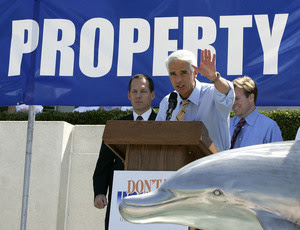
"Crist: Don't increase the sales tax
With the House and Senate stalled on property tax cuts, the governor weighed in.
BY MARY ELLEN KLAS AND MARC CAPUTO
meklas@MiamiHerald.com
PHIL COALE/AP
Gov. Charlie Crist talks to a group of builders, contractors and home building professionals at the Florida Capitol for a rally on property tax reform on Tuesday in Tallahassee.
TALLAHASSEE -- As legislative negotiations over cutting property taxes stalled for a second day, Gov. Charlie Crist entered the arena Tuesday, signaling he rejects a House idea to hike sales taxes to make up for deep property tax cuts, but also wants bigger cuts than the Senate is offering.
Crist called the House plan to eliminate property taxes on primary homes and replace them with a 2.5-cent hike in the sales tax ''an intriguing idea,'' but added: ``We have to do the doable, though.''
The governor's comments came as Senate leaders rejected the House proposal as ''unpassable.'' House leaders then rebuffed a Senate offer to deepen its proposed tax cut to $15 billion over five years -- $3 billion more than the Senate's previous position.
Crist called the House plan to eliminate property taxes on primary homes and replace them with a 2.5-cent hike in the sales tax ''an intriguing idea,'' but added: ``We have to do the doable, though.''
The governor's comments came as Senate leaders rejected the House proposal as ''unpassable.'' House leaders then rebuffed a Senate offer to deepen its proposed tax cut to $15 billion over five years -- $3 billion more than the Senate's previous position.
The House lead negotiator, Republican Rep. Dean Cannon of Winter Park, said the tax savings offered by the Senate are ''statistically insignificant,'' compared to the House's promise to save $44 billion over the same time.
Though Crist appears to oppose a sales-tax increase, he is closer to the House when it comes to forcing local governments to scale back their tax bases to the 2004 or 2005 budget year. That position alone may help bickering legislators refocus their discontent on a common foe: local governments, which have seen their revenues rise $50 billion statewide in the past eight years.
WASTE CITED
In a 13-page document prepared by the governor's policy and budget staff, the governor listed 13 examples of waste in government and presented a chart that labels responsible growth at 42 percent across all government services, rather than the higher levels counties and cities have experienced.
The House also has made governments the foe in the tax wars, suggesting that legislators are concerned only about how taxpayers -- not governments -- fare under the cuts.
Crist appears to be leaning toward the Senate position on other issues, however. He supports allowing homeowners to take savings from the state's property tax cap with them when they move, a practice known as portability.
He didn't indicate, though, whether he supports the Senate approach of imposing a higher tax cap for homeowners who take advantage of the savings. And he supports the Senate proposal to give first-time home buyers a tax break.
The governor also appears to be holding firm to the idea of doubling the homestead exemption, now at $25,000, for all homeowners. The idea has not been included in either the House or Senate tax-cut plans.
The governor's office estimated the total savings under his proposal at $23 billion over five years and $2 billion to $3 billion next year, depending on which year the tax rollback occurs. The average savings for homeowners would be either 6.5 percent or 9.3 percent.
`IDEAS ONLY'
The document offers no specifics but was titled: ``Governor's Recommendation to Legislature, Property Tax Reform.''
In a 13-page document prepared by the governor's policy and budget staff, the governor listed 13 examples of waste in government and presented a chart that labels responsible growth at 42 percent across all government services, rather than the higher levels counties and cities have experienced.
The House also has made governments the foe in the tax wars, suggesting that legislators are concerned only about how taxpayers -- not governments -- fare under the cuts.
Crist appears to be leaning toward the Senate position on other issues, however. He supports allowing homeowners to take savings from the state's property tax cap with them when they move, a practice known as portability.
He didn't indicate, though, whether he supports the Senate approach of imposing a higher tax cap for homeowners who take advantage of the savings. And he supports the Senate proposal to give first-time home buyers a tax break.
The governor also appears to be holding firm to the idea of doubling the homestead exemption, now at $25,000, for all homeowners. The idea has not been included in either the House or Senate tax-cut plans.
The governor's office estimated the total savings under his proposal at $23 billion over five years and $2 billion to $3 billion next year, depending on which year the tax rollback occurs. The average savings for homeowners would be either 6.5 percent or 9.3 percent.
`IDEAS ONLY'
The document offers no specifics but was titled: ``Governor's Recommendation to Legislature, Property Tax Reform.''
Crist, who until now has made only upbeat but vague comments about the Legislature's property tax proposals, crossed out those words and wrote ''Ideas only'' before it was distributed to the press.
As Crist conducted the first in a series of hastily called town hall meetings on property taxes in West Palm Beach Tuesday night, the talks between the House and Senate soured.
Senate Republican Leader Dan Webster of Winter Garden used his most forceful language yet when he said the chamber considers the House plan unpassable, because it relies on a constitutional amendment to swap property taxes for sales taxes.
He said he is ''100 percent sure'' the House plan will never win the approval of two-thirds of voters it needs to pass. Though eliminating all property taxes on homesteaded homes would make homeowners happy, he said, the idea would antagonize other voters, such as renters and the owners of businesses or second homes.
So legislators should focus on rolling back property tax collections to provide immediate tax savings, Webster said.
STILL WAITING
After the Senate made its offer, Cannon, the House's lead negotiator, said his chamber is ''still looking forward'' to the Senate plan, as if one hadn't been offered.
As Cannon spoke, Sen. Mike Haridopolos, the Melbourne Republican who leads Senate negotiations, stood shoulder-to-shoulder with him. Both faced forward, barely looking at each other and speaking to reporters instead.
As Crist conducted the first in a series of hastily called town hall meetings on property taxes in West Palm Beach Tuesday night, the talks between the House and Senate soured.
Senate Republican Leader Dan Webster of Winter Garden used his most forceful language yet when he said the chamber considers the House plan unpassable, because it relies on a constitutional amendment to swap property taxes for sales taxes.
He said he is ''100 percent sure'' the House plan will never win the approval of two-thirds of voters it needs to pass. Though eliminating all property taxes on homesteaded homes would make homeowners happy, he said, the idea would antagonize other voters, such as renters and the owners of businesses or second homes.
So legislators should focus on rolling back property tax collections to provide immediate tax savings, Webster said.
STILL WAITING
After the Senate made its offer, Cannon, the House's lead negotiator, said his chamber is ''still looking forward'' to the Senate plan, as if one hadn't been offered.
As Cannon spoke, Sen. Mike Haridopolos, the Melbourne Republican who leads Senate negotiations, stood shoulder-to-shoulder with him. Both faced forward, barely looking at each other and speaking to reporters instead.
''The numbers don't lie,'' Haridpolos said firmly. ''The numbers are clear: $15.33 billion. That's movement,'' he said.
He noted that the original Senate plan called for $12.3 billion in savings over five years. Counties would roll back their tax base by $8.8 billion and cities by $3.7 billion. Special taxing districts, such as water management districts and children's services councils, would see their tax base cut $422 million.
''We have made a positive step forward today,'' Haridopolos said. ``We expect that positive steps will be made forward in the counter offer.''
Said Cannon: ``At this rate, it may take us a couple years to get to our numbers, but that's OK. We'll wait till we get there.''"
Said Cannon: ``At this rate, it may take us a couple years to get to our numbers, but that's OK. We'll wait till we get there.''"
Tuesday, April 24, 2007
Democrats unite on Iraq
"The World; Democrats unite on Iraq pullout plan; The bill sets no firm deadline and Bush will veto it. But it marks a historic challenge to a wartime president.
Source: Los Angeles Times 04/24/2007
WASHINGTON
Setting in motion a promised showdown with the White House, Democratic congressional leaders united Monday behind an emergency war spending measure that requires the president to begin withdrawing troops from Iraq no later than this fall.
The $124-billion compromise, which does not include a firm deadline for President Bush to complete a troop withdrawal, is headed for a certain veto.
But as Congress and the White House face off over the course of U.S. policy in Iraq, the agreement marked the prologue for a week that could produce the most serious legislative challenge to a wartime president since the Vietnam era.
The House and Senate, with the support of most Democrats, are expected to approve the measure by Thursday.
Bush, who has used his veto just once, to block an expansion of federal support for embryonic stem cell research, is expected to invoke that power again.
Democrats can't muster enough votes to override a veto. But they said they would keep up the pressure on Bush to end the U.S. combat role in the 4-year-old war, and hinted that they would send the president a funding bill without timelines for pulling out troops.
"We may not be able to prevent President Bush from vetoing our supplemental bill, but we can and will keep trying to change his mind," Senate Majority Leader Harry Reid (D-Nev.) said in a speech at the Woodrow Wilson International Center for Scholars in Washington.
Reid contrasted the Democratic proposal with what he called Bush's "mistakes and mismanagement."
"No more will Congress turn a blind eye to the Bush administration's incompetence and dishonesty," said Reid, who in recent months has become one of Congress' sharpest critics of the war.
Bush argues that setting dates for bringing troops home would allow America's enemies to wait out U.S. forces.
"Politicians in Washington shouldn't be telling generals how to do their job," Bush said after meeting at the White House with Army Gen. David H. Petraeus, the top American commander in Iraq.
Petraeus, a highly respected combat veteran who has become the president's best salesman for the troop buildup, will brief lawmakers this week about the progress of Bush's plan.
"I will strongly reject an artificial timetable," Bush said, reiterating a promise he has made with increasing frequency as the confrontation between the two branches of government has intensified.
But Democrats, emboldened by public opposition to the war and disenchantment with Bush, show no signs of relenting in their campaign to compel the White House to start bringing U.S. troops home.
Nor does there appear to be much discord over the war in the famously fractious party. Even many of the war's staunchest congressional opponents, who had pressed to require a withdrawal by year's end, have signaled they will back the compromise worked out by Democratic leaders.
"What is important is not the specific language.... What is important is the unity we express," said Rep. David R. Obey (D-Wis.), who heads the House Appropriations Committee and is one of the architects of the compromise.
*
Reaching a deal
A few weeks ago, it was unclear whether House and Senate Democrats would be able to agree to any timeline to withdraw U.S. forces.
Senate Democrats narrowly passed a spending bill with a timeline that demanded troop withdrawals to begin within 120 days of enactment.
But they avoided a deadline to complete the pullout, in deference to moderates who feared imposing too many limitations on the military.
The plan set a nonbinding goal of completing the withdrawal by March 31.
In the House, Speaker Nancy Pelosi (D-San Francisco) and her lieutenants were forced to toughen the timelines to accommodate lawmakers on the other end of the ideological spectrum.
The House plan, which was considerably more complicated, set out a mandatory timeline linked to the Iraqi government's progress in disarming militias. It also amended the Iraqi constitution and took steps to reduce sectarian strife.
The House required Bush to complete the withdrawal by August 2008, or earlier if the Iraqi government failed to show progress.
In a nod to moderate Senate Democrats, the compromise approved Monday sets a nonbinding goal for completing a withdrawal.
But it maintains the link between the withdrawal timeline and the performance of the Iraqi government.
The compromise calls for a withdrawal to begin July 1 if Bush does not certify that the Iraqi government is making progress on a series of "reconciliation initiatives," with a goal of completing the withdrawal within 180 days, which would end Dec. 27.
If Bush demonstrates that the Iraqi government is making progress, the Democratic plan mandates that the withdrawal begin Oct. 1, and sets a goal to complete the pullout by March 28.
Like the earlier House and Senate proposals, the compromise allows some U.S. troops to remain to train Iraqi forces, protect American interests and conduct limited counter-terrorism operations.
It also requires Bush to explain why he is deploying military units abroad if the forces have not met readiness standards, including adequate training and rest at their home bases.
*
Non-military spending
Democrats responded to one of Bush's key criticisms of the legislation. They stripped out money for spinach farmers and peanut storage, which the president had ridiculed as pork-barrel spending.
But they retained billions of dollars for non-military spending, including money to rebuild the Gulf Coast, to combat the threat of bird flu and to help the agriculture industry, including dairy farmers.
The plan was quickly approved by a conference committee of senior House and Senate lawmakers.
There were few signs of dissent among Democrats.
"This will work for now," said Sen. Ben Nelson of Nebraska, a moderate who cast a crucial vote for the Senate bill last month. "When you know the next three chess moves, you go ahead and play."
Republican lawmakers disparaged the Democratic proposal, complaining that it micromanages the war and emboldens terrorists in Iraq and elsewhere.
But with the legislation headed for a veto, Republican lawmakers have shown little inclination to try to derail it.
Rep. Jerry Lewis (R-Redlands) said he hoped Democrats would swiftly pass the measure so Bush could veto it and lawmakers could put together a funding bill without timelines to withdraw troops.
"We all know this bill is going nowhere fast," Lewis said. "
Source: Los Angeles Times 04/24/2007
WASHINGTON
Setting in motion a promised showdown with the White House, Democratic congressional leaders united Monday behind an emergency war spending measure that requires the president to begin withdrawing troops from Iraq no later than this fall.
The $124-billion compromise, which does not include a firm deadline for President Bush to complete a troop withdrawal, is headed for a certain veto.
But as Congress and the White House face off over the course of U.S. policy in Iraq, the agreement marked the prologue for a week that could produce the most serious legislative challenge to a wartime president since the Vietnam era.
The House and Senate, with the support of most Democrats, are expected to approve the measure by Thursday.
Bush, who has used his veto just once, to block an expansion of federal support for embryonic stem cell research, is expected to invoke that power again.
Democrats can't muster enough votes to override a veto. But they said they would keep up the pressure on Bush to end the U.S. combat role in the 4-year-old war, and hinted that they would send the president a funding bill without timelines for pulling out troops.
"We may not be able to prevent President Bush from vetoing our supplemental bill, but we can and will keep trying to change his mind," Senate Majority Leader Harry Reid (D-Nev.) said in a speech at the Woodrow Wilson International Center for Scholars in Washington.
Reid contrasted the Democratic proposal with what he called Bush's "mistakes and mismanagement."
"No more will Congress turn a blind eye to the Bush administration's incompetence and dishonesty," said Reid, who in recent months has become one of Congress' sharpest critics of the war.
Bush argues that setting dates for bringing troops home would allow America's enemies to wait out U.S. forces.
"Politicians in Washington shouldn't be telling generals how to do their job," Bush said after meeting at the White House with Army Gen. David H. Petraeus, the top American commander in Iraq.
Petraeus, a highly respected combat veteran who has become the president's best salesman for the troop buildup, will brief lawmakers this week about the progress of Bush's plan.
"I will strongly reject an artificial timetable," Bush said, reiterating a promise he has made with increasing frequency as the confrontation between the two branches of government has intensified.
But Democrats, emboldened by public opposition to the war and disenchantment with Bush, show no signs of relenting in their campaign to compel the White House to start bringing U.S. troops home.
Nor does there appear to be much discord over the war in the famously fractious party. Even many of the war's staunchest congressional opponents, who had pressed to require a withdrawal by year's end, have signaled they will back the compromise worked out by Democratic leaders.
"What is important is not the specific language.... What is important is the unity we express," said Rep. David R. Obey (D-Wis.), who heads the House Appropriations Committee and is one of the architects of the compromise.
*
Reaching a deal
A few weeks ago, it was unclear whether House and Senate Democrats would be able to agree to any timeline to withdraw U.S. forces.
Senate Democrats narrowly passed a spending bill with a timeline that demanded troop withdrawals to begin within 120 days of enactment.
But they avoided a deadline to complete the pullout, in deference to moderates who feared imposing too many limitations on the military.
The plan set a nonbinding goal of completing the withdrawal by March 31.
In the House, Speaker Nancy Pelosi (D-San Francisco) and her lieutenants were forced to toughen the timelines to accommodate lawmakers on the other end of the ideological spectrum.
The House plan, which was considerably more complicated, set out a mandatory timeline linked to the Iraqi government's progress in disarming militias. It also amended the Iraqi constitution and took steps to reduce sectarian strife.
The House required Bush to complete the withdrawal by August 2008, or earlier if the Iraqi government failed to show progress.
In a nod to moderate Senate Democrats, the compromise approved Monday sets a nonbinding goal for completing a withdrawal.
But it maintains the link between the withdrawal timeline and the performance of the Iraqi government.
The compromise calls for a withdrawal to begin July 1 if Bush does not certify that the Iraqi government is making progress on a series of "reconciliation initiatives," with a goal of completing the withdrawal within 180 days, which would end Dec. 27.
If Bush demonstrates that the Iraqi government is making progress, the Democratic plan mandates that the withdrawal begin Oct. 1, and sets a goal to complete the pullout by March 28.
Like the earlier House and Senate proposals, the compromise allows some U.S. troops to remain to train Iraqi forces, protect American interests and conduct limited counter-terrorism operations.
It also requires Bush to explain why he is deploying military units abroad if the forces have not met readiness standards, including adequate training and rest at their home bases.
*
Non-military spending
Democrats responded to one of Bush's key criticisms of the legislation. They stripped out money for spinach farmers and peanut storage, which the president had ridiculed as pork-barrel spending.
But they retained billions of dollars for non-military spending, including money to rebuild the Gulf Coast, to combat the threat of bird flu and to help the agriculture industry, including dairy farmers.
The plan was quickly approved by a conference committee of senior House and Senate lawmakers.
There were few signs of dissent among Democrats.
"This will work for now," said Sen. Ben Nelson of Nebraska, a moderate who cast a crucial vote for the Senate bill last month. "When you know the next three chess moves, you go ahead and play."
Republican lawmakers disparaged the Democratic proposal, complaining that it micromanages the war and emboldens terrorists in Iraq and elsewhere.
But with the legislation headed for a veto, Republican lawmakers have shown little inclination to try to derail it.
Rep. Jerry Lewis (R-Redlands) said he hoped Democrats would swiftly pass the measure so Bush could veto it and lawmakers could put together a funding bill without timelines to withdraw troops.
"We all know this bill is going nowhere fast," Lewis said. "
Medicare's financial health
The responsible action of U.S. politicians in regards to the funding of programs like Medicare and Social Security should ideally be to fully fund. For example, under the leadership of President Bill Clinton we did not experience such partisan propaganda reports intended to shed a negative light on such programs. America did then experience sincere efforts to make these programs solvent. I am confident in my view in regards to entitlements and ask conservatives to pause for a moment for rethinking your policy; what is the value of American citizenship if being a U.S. citizen does not entitle you to benefits greater than other industrialized nations? Conservative policy, which I oppose as it relates to programs of social uplift, seeks to create a government that’s sole function is to protect. Such moves would take American society back to the dark ages. Security in Healthcare and retirement for all U.S. citizens should not be viewed as handouts or degraded by comparing them with programs such as welfare. This is the work of government. The founding fathers of the United States did not form this government solely to fund an army but far more paramount as stated first in the Constitution, to provide services promoting "the pursuit of happiness" for all American citizens. The current political approach in Washington D.C. is tantamount to a vision of government that holds power but lacks in accountability. An unacceptable approach however in my opinion.
-A.T. Brooks
The Nation; Alarm sounded on Medicare's financial health; Trustees warn that the program's mammoth hospitalization trust fund is projected to run a deficit in 2019.
Source: Los Angeles Times 04/24/2007
WASHINGTON
Medicare's trustees warned Monday that the program was in critical financial condition, setting in motion a process that could ignite a fierce debate during the 2008 presidential campaign over benefit cuts and tax increases.
The trustees projected that Medicare's hospitalization trust fund would probably slip into the red in 2019. Social Security is not expected to exhaust its reserves until 2041.
The trustees' statements amount to an annual status report on the government's two biggest benefit programs and the most important retirement safeguards for the middle class. In recent years, the trustees repeatedly raised the prospect of a financial crisis as the nation's 78 million baby boomers moved closer to retirement.
This year's formal warning triggers a legal requirement that the president and Congress work toward a solution. And that could ignite a political dust-up.
Social Security and Medicare are financed mainly by taxes evenly divided between workers and employers that amount to 15.3% of wages.
Medicare also relies heavily on the government's general fund -- part of a complex arrangement that led to Monday's warning.
Under a 2003 law, the trustees were required to issue a warning if two consecutive reports projected that Medicare would draw 45% or more of its financing from the general fund within seven years. The first such estimate came last year.
Now, as part of his next budget, President Bush must propose a way to deal with the funding imbalance. Lawmakers must immediately consider the proposal, but neither the president nor Congress is bound to pass a new law.
Bush does not have to make a proposal until next year, when he submits his 2009 budget. But he already called for automatic spending cuts if the warning was triggered, and for higher premiums for wealthy seniors in Medicare's prescription program.
Neither the House nor the Senate version of the 2008 budget contains any savings from Medicare or Social Security. Bringing the programs into balance will require political compromises most likely to involve spending cuts and tax increases.
"The next president is going to have to deal with these issues," said Robert L. Bixby, executive director of the Concord Coalition, a nonpartisan group that advocates reducing the federal deficit. "It's important that presidential campaigns on both sides pay attention to these numbers and not take any options off the table."
That the first baby boomers, defined as people born between 1946 and 1964, will turn 65 in four years underscores the concerns about the programs.
"If we do not take action soon, the coming demographic bulge will compromise the programs' ability to support people who depend on them," said Treasury Secretary Henry M. Paulson Jr., one of four high-ranking government officials who serve as trustees.
Two independent experts, appointed to represent the public, round out the six trustees.
"While the [Medicare] warning is new, it simply reflects the same dire fiscal reality we've been reporting for years, and that has been exacerbated by the addition of the new prescription benefit," said John L. Palmer, an economics professor at Syracuse University and a public trustee. "If anything ... the challenge here has been understated."
Many Democrats and advocates for seniors see the Medicare warning as little more than a gimmick.
They say the same GOP-led Congress that instituted the warning requirement also created the Medicare prescription drug benefit, which increased spending and the likelihood that a warning would be triggered.
"It's kind of a crazy warning because it doesn't focus attention on what's important," said John Rother, director of policy and strategy for AARP, the seniors lobby.
Rep. Pete Stark (D-Fremont), chairman of a health subcommittee, called the warning "an arbitrary threshold designed to scare people."
Rother said the trustees' report also showed that the rate of increase in Medicare costs had eased slightly. "That's very good news," he said. "The movement is in the right direction."
In the past, other warnings have prompted bipartisan action to tackle thorny issues on program cuts and tax increases. It's unclear whether that will happen this time.
"We shouldn't be waiting for alarms to go off, but they may help spur much-needed and long-overdue action," said David M. Walker, head of the Government Accountability Office. "The real key is ... will policymakers act, or will they push the snooze button?"
Walker has been traveling around the country to call attention to the government's long-range fiscal problems.
The trustees' report included calculations to show the breadth of the financial gap in the programs.
The Social Security shortfall would require a 16% payroll tax increase or a 13% cut in benefits, or some combination.
Medicare is trickier, mostly because healthcare costs are rising faster than other economic indicators.
To bring the program's giant hospitalization trust fund into balance would require more than doubling the 2.9% Medicare payroll tax or program cuts of 51%, or some combination of the two.
Congress and Bush probably won't do either this year. More likely, they will increase Medicare spending by staving off a planned cut in doctors' fees.
-A.T. Brooks
The Nation; Alarm sounded on Medicare's financial health; Trustees warn that the program's mammoth hospitalization trust fund is projected to run a deficit in 2019.
Source: Los Angeles Times 04/24/2007
WASHINGTON
Medicare's trustees warned Monday that the program was in critical financial condition, setting in motion a process that could ignite a fierce debate during the 2008 presidential campaign over benefit cuts and tax increases.
The trustees projected that Medicare's hospitalization trust fund would probably slip into the red in 2019. Social Security is not expected to exhaust its reserves until 2041.
The trustees' statements amount to an annual status report on the government's two biggest benefit programs and the most important retirement safeguards for the middle class. In recent years, the trustees repeatedly raised the prospect of a financial crisis as the nation's 78 million baby boomers moved closer to retirement.
This year's formal warning triggers a legal requirement that the president and Congress work toward a solution. And that could ignite a political dust-up.
Social Security and Medicare are financed mainly by taxes evenly divided between workers and employers that amount to 15.3% of wages.
Medicare also relies heavily on the government's general fund -- part of a complex arrangement that led to Monday's warning.
Under a 2003 law, the trustees were required to issue a warning if two consecutive reports projected that Medicare would draw 45% or more of its financing from the general fund within seven years. The first such estimate came last year.
Now, as part of his next budget, President Bush must propose a way to deal with the funding imbalance. Lawmakers must immediately consider the proposal, but neither the president nor Congress is bound to pass a new law.
Bush does not have to make a proposal until next year, when he submits his 2009 budget. But he already called for automatic spending cuts if the warning was triggered, and for higher premiums for wealthy seniors in Medicare's prescription program.
Neither the House nor the Senate version of the 2008 budget contains any savings from Medicare or Social Security. Bringing the programs into balance will require political compromises most likely to involve spending cuts and tax increases.
"The next president is going to have to deal with these issues," said Robert L. Bixby, executive director of the Concord Coalition, a nonpartisan group that advocates reducing the federal deficit. "It's important that presidential campaigns on both sides pay attention to these numbers and not take any options off the table."
That the first baby boomers, defined as people born between 1946 and 1964, will turn 65 in four years underscores the concerns about the programs.
"If we do not take action soon, the coming demographic bulge will compromise the programs' ability to support people who depend on them," said Treasury Secretary Henry M. Paulson Jr., one of four high-ranking government officials who serve as trustees.
Two independent experts, appointed to represent the public, round out the six trustees.
"While the [Medicare] warning is new, it simply reflects the same dire fiscal reality we've been reporting for years, and that has been exacerbated by the addition of the new prescription benefit," said John L. Palmer, an economics professor at Syracuse University and a public trustee. "If anything ... the challenge here has been understated."
Many Democrats and advocates for seniors see the Medicare warning as little more than a gimmick.
They say the same GOP-led Congress that instituted the warning requirement also created the Medicare prescription drug benefit, which increased spending and the likelihood that a warning would be triggered.
"It's kind of a crazy warning because it doesn't focus attention on what's important," said John Rother, director of policy and strategy for AARP, the seniors lobby.
Rep. Pete Stark (D-Fremont), chairman of a health subcommittee, called the warning "an arbitrary threshold designed to scare people."
Rother said the trustees' report also showed that the rate of increase in Medicare costs had eased slightly. "That's very good news," he said. "The movement is in the right direction."
In the past, other warnings have prompted bipartisan action to tackle thorny issues on program cuts and tax increases. It's unclear whether that will happen this time.
"We shouldn't be waiting for alarms to go off, but they may help spur much-needed and long-overdue action," said David M. Walker, head of the Government Accountability Office. "The real key is ... will policymakers act, or will they push the snooze button?"
Walker has been traveling around the country to call attention to the government's long-range fiscal problems.
The trustees' report included calculations to show the breadth of the financial gap in the programs.
The Social Security shortfall would require a 16% payroll tax increase or a 13% cut in benefits, or some combination.
Medicare is trickier, mostly because healthcare costs are rising faster than other economic indicators.
To bring the program's giant hospitalization trust fund into balance would require more than doubling the 2.9% Medicare payroll tax or program cuts of 51%, or some combination of the two.
Congress and Bush probably won't do either this year. More likely, they will increase Medicare spending by staving off a planned cut in doctors' fees.
Subscribe to:
Posts (Atom)

