Presidential candidates Gov. Bill Richardson and Sen. John McCain are utilizing a strategy from G.W. Bush's playbook. They are using phrases like " things" and "I know what I want". I despised hearing G.W. Bush use such terms without giving specifics, maybe I'm on a limb but I'd guess that most other Americans will also never again vote for a president who leaves such blanks in their agenda. I could care less for a candidate who runs on “I know what I want”. What I care about is a candidate’s clear articulation of their plans towards advancing the nation.
"Source: Associated Press Newswires 04/26/2007
WASHINGTON (AP) -
For presidential hopefuls, it's called the Expectations Game.
Here's how it's played: Before a debate, rival campaigns build up the skills of their opponents while downgrading their own candidate's verbal abilities. That way, any bright moments make a performance seem like a home run.
For the Democratic hopefuls, the first major round of the Expectations Game came ahead of Thursday night's debate at South Carolina State University in Orangeburg, S.C. The 90-minute event offers eight candidates their initial chance to distinguish themselves on the long road to the nomination next year.
"I've just got to make sure I don't trip walking on the stage," joked Delaware Sen. Joe Biden, who complained that the candidates get no opening or closing statements and that responses to questions are limited to 60 seconds.
Illinois Sen. Barack Obama cracked, "It takes me 60 seconds to clear my throat."
Such self-deprecating comments before a debate are common in the Expectations Game. So is anonymous praise.
One of Sen. Hillary Rodham Clinton's rivals tried to set high stakes for her performance by sharing with a reporter a 1990 editorial in the Arkansas Democrat-Gazette. Clinton, as first lady of Arkansas, once turned a news conference staged by her husband's Republican challenger into an impromptu debate. "The tougher Clinton" went on to "mop the marble floor with her husband's opponent," the newspaper contended.
In a similar bit of gamesmanship, an Obama opponent tried to raise the bar for the Illinois senator by pointing out to a reporter that he had been editor of the Harvard Law Review and rose to prominence on the strength of his rhetorical skills. The campaign cited a letter to the editor in The Seattle Times last February that claimed Abraham Lincoln would have lost his election if he had to debate Obama instead of Stephen Douglas.
And a rival camp to former Sen. John Edwards recalled in an e-mail to a reporter his accomplishments as a trial lawyer. Extolling his intense preparations and his ability to win over the jury, the rival provided several news clips hailing his previous debate performances.
Such praise usually ends as soon as the talk begins.
Because of her front-runner status, Clinton could be a target for those trying to get attention. Obama, too, could be a popular mark because of his rise to prominence after just three years in the Senate.
So far, the candidates have been relying mostly on indirect criticisms of one another.
"Hope alone is not going to restore America's leadership," Connecticut Sen. Chris Dodd said in a speech Tuesday. "Like never before I believe we need national leadership that's ready to lead from Day One."
Dodd denied afterward that he was trying to compare himself to Obama. But he left it to others to fill in the blanks.
Dodd played down the importance of the debate but said his preparations involved "about 32 years" -- the time he's served in Congress.
With his short time on Capitol Hill, Obama was doing much more. His campaign was mum about specifics, but it confirmed that he had spent quite a bit of time preparing.
"I don't do any preparations at all. I'm just going to wing it," Obama said with a smile when asked about it. Then he allowed, "Of course I'm doing a little preparation."
Clinton spokesman Howard Wolfson said she was reviewing notes and going through mock question-and-answer sessions. The campaign sent an e-mail to supporters Tuesday to encourage them to hold debate-watching parties.
"She is going down there prepared to make her case that she has the strength and experience to lead from Day One," Wolfson said.
New Mexico Gov. Bill Richardson planned a full day of debate prep in South Carolina on Thursday. "I'm going to show I'm the candidate who not only has experience, but I've actually done things," he said.
Edwards campaign officials revealed one proposal he was ready to discuss: Calling on President Bush to fire adviser Karl Rove for his alleged role in the federal prosecutor firing scandal.
"NBC Nightly News" anchor Brian Williams was set to moderate the MSNBC debate, which was being hosted by the university and the South Carolina Democratic Party. Special software designed by the network will keep track of how long each candidate gets on the air to ensure equal time.
That's just about 11 minutes per candidate. Long shots like former Alaska Sen. Mike Gravel and Ohio Rep. Dennis Kucinich would get just as much time to explain their views as their better-known rivals. "
Friday, April 27, 2007


Wednesday, April 25, 2007
Impeachment Movement Sweeping the Country

“The winds of impeachment are sweeping the country.” - Ramsey Clark, Former U.S. Attorney General
The Impeachment movement is catching its second wind. It is not too late.
The Honorable Rep. Dennis Kucinich has proposed legislation to remove Vice President Dick Cheney from office. Lets rally around these efforts and offer Kucinich our full support. Residents of Sarasota County I encourage you to put pressure on Rep. Vern Buchanan to join as a sponsor of Kucinich’s legislation.
Checks & Balances Blog fully endorses these impeachment efforts.
Congressman Dennis Kucinich has acted. Here are his Articles of Impeachment and supporting materials. It's time now for us to follow through by asking the rest of Congress to get on board with the American public, and by letting the media know where we stand.
http://www.impeachcheney.org
Ask your Congress Member to support impeachment proceedings against Vice President Cheney:
http://tinyurl.com/yttnxq
Ask members of the House Judiciary Committee and Speaker Nancy Pelosi to lead, follow, or get out of the way:
http://tinyurl.com/2ar8ch
Tell the media that you support Congressman Dennis Kucinich's proposal to begin impeachment proceedings:
http://tinyurl.com/2cag7t
The Impeachment movement is catching its second wind. It is not too late.
The Honorable Rep. Dennis Kucinich has proposed legislation to remove Vice President Dick Cheney from office. Lets rally around these efforts and offer Kucinich our full support. Residents of Sarasota County I encourage you to put pressure on Rep. Vern Buchanan to join as a sponsor of Kucinich’s legislation.
Checks & Balances Blog fully endorses these impeachment efforts.
Congressman Dennis Kucinich has acted. Here are his Articles of Impeachment and supporting materials. It's time now for us to follow through by asking the rest of Congress to get on board with the American public, and by letting the media know where we stand.
http://www.impeachcheney.org
Ask your Congress Member to support impeachment proceedings against Vice President Cheney:
http://tinyurl.com/yttnxq
Ask members of the House Judiciary Committee and Speaker Nancy Pelosi to lead, follow, or get out of the way:
http://tinyurl.com/2ar8ch
Tell the media that you support Congressman Dennis Kucinich's proposal to begin impeachment proceedings:
http://tinyurl.com/2cag7t
Crist rejects regressive sales tax hike
"Crist: Don't increase the sales tax
With the House and Senate stalled on property tax cuts, the governor weighed in.
BY MARY ELLEN KLAS AND MARC CAPUTO
meklas@MiamiHerald.com
PHIL COALE/AP
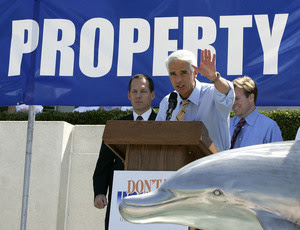
Gov. Charlie Crist talks to a group of builders, contractors and home building professionals at the Florida Capitol for a rally on property tax reform on Tuesday in Tallahassee.
TALLAHASSEE -- As legislative negotiations over cutting property taxes stalled for a second day, Gov. Charlie Crist entered the arena Tuesday, signaling he rejects a House idea to hike sales taxes to make up for deep property tax cuts, but also wants bigger cuts than the Senate is offering.
Crist called the House plan to eliminate property taxes on primary homes and replace them with a 2.5-cent hike in the sales tax ''an intriguing idea,'' but added: ``We have to do the doable, though.''
The governor's comments came as Senate leaders rejected the House proposal as ''unpassable.'' House leaders then rebuffed a Senate offer to deepen its proposed tax cut to $15 billion over five years -- $3 billion more than the Senate's previous position.
Crist called the House plan to eliminate property taxes on primary homes and replace them with a 2.5-cent hike in the sales tax ''an intriguing idea,'' but added: ``We have to do the doable, though.''
The governor's comments came as Senate leaders rejected the House proposal as ''unpassable.'' House leaders then rebuffed a Senate offer to deepen its proposed tax cut to $15 billion over five years -- $3 billion more than the Senate's previous position.
The House lead negotiator, Republican Rep. Dean Cannon of Winter Park, said the tax savings offered by the Senate are ''statistically insignificant,'' compared to the House's promise to save $44 billion over the same time.
Though Crist appears to oppose a sales-tax increase, he is closer to the House when it comes to forcing local governments to scale back their tax bases to the 2004 or 2005 budget year. That position alone may help bickering legislators refocus their discontent on a common foe: local governments, which have seen their revenues rise $50 billion statewide in the past eight years.
WASTE CITED
In a 13-page document prepared by the governor's policy and budget staff, the governor listed 13 examples of waste in government and presented a chart that labels responsible growth at 42 percent across all government services, rather than the higher levels counties and cities have experienced.
The House also has made governments the foe in the tax wars, suggesting that legislators are concerned only about how taxpayers -- not governments -- fare under the cuts.
Crist appears to be leaning toward the Senate position on other issues, however. He supports allowing homeowners to take savings from the state's property tax cap with them when they move, a practice known as portability.
He didn't indicate, though, whether he supports the Senate approach of imposing a higher tax cap for homeowners who take advantage of the savings. And he supports the Senate proposal to give first-time home buyers a tax break.
The governor also appears to be holding firm to the idea of doubling the homestead exemption, now at $25,000, for all homeowners. The idea has not been included in either the House or Senate tax-cut plans.
The governor's office estimated the total savings under his proposal at $23 billion over five years and $2 billion to $3 billion next year, depending on which year the tax rollback occurs. The average savings for homeowners would be either 6.5 percent or 9.3 percent.
`IDEAS ONLY'
The document offers no specifics but was titled: ``Governor's Recommendation to Legislature, Property Tax Reform.''
In a 13-page document prepared by the governor's policy and budget staff, the governor listed 13 examples of waste in government and presented a chart that labels responsible growth at 42 percent across all government services, rather than the higher levels counties and cities have experienced.
The House also has made governments the foe in the tax wars, suggesting that legislators are concerned only about how taxpayers -- not governments -- fare under the cuts.
Crist appears to be leaning toward the Senate position on other issues, however. He supports allowing homeowners to take savings from the state's property tax cap with them when they move, a practice known as portability.
He didn't indicate, though, whether he supports the Senate approach of imposing a higher tax cap for homeowners who take advantage of the savings. And he supports the Senate proposal to give first-time home buyers a tax break.
The governor also appears to be holding firm to the idea of doubling the homestead exemption, now at $25,000, for all homeowners. The idea has not been included in either the House or Senate tax-cut plans.
The governor's office estimated the total savings under his proposal at $23 billion over five years and $2 billion to $3 billion next year, depending on which year the tax rollback occurs. The average savings for homeowners would be either 6.5 percent or 9.3 percent.
`IDEAS ONLY'
The document offers no specifics but was titled: ``Governor's Recommendation to Legislature, Property Tax Reform.''
Crist, who until now has made only upbeat but vague comments about the Legislature's property tax proposals, crossed out those words and wrote ''Ideas only'' before it was distributed to the press.
As Crist conducted the first in a series of hastily called town hall meetings on property taxes in West Palm Beach Tuesday night, the talks between the House and Senate soured.
Senate Republican Leader Dan Webster of Winter Garden used his most forceful language yet when he said the chamber considers the House plan unpassable, because it relies on a constitutional amendment to swap property taxes for sales taxes.
He said he is ''100 percent sure'' the House plan will never win the approval of two-thirds of voters it needs to pass. Though eliminating all property taxes on homesteaded homes would make homeowners happy, he said, the idea would antagonize other voters, such as renters and the owners of businesses or second homes.
So legislators should focus on rolling back property tax collections to provide immediate tax savings, Webster said.
STILL WAITING
After the Senate made its offer, Cannon, the House's lead negotiator, said his chamber is ''still looking forward'' to the Senate plan, as if one hadn't been offered.
As Cannon spoke, Sen. Mike Haridopolos, the Melbourne Republican who leads Senate negotiations, stood shoulder-to-shoulder with him. Both faced forward, barely looking at each other and speaking to reporters instead.
As Crist conducted the first in a series of hastily called town hall meetings on property taxes in West Palm Beach Tuesday night, the talks between the House and Senate soured.
Senate Republican Leader Dan Webster of Winter Garden used his most forceful language yet when he said the chamber considers the House plan unpassable, because it relies on a constitutional amendment to swap property taxes for sales taxes.
He said he is ''100 percent sure'' the House plan will never win the approval of two-thirds of voters it needs to pass. Though eliminating all property taxes on homesteaded homes would make homeowners happy, he said, the idea would antagonize other voters, such as renters and the owners of businesses or second homes.
So legislators should focus on rolling back property tax collections to provide immediate tax savings, Webster said.
STILL WAITING
After the Senate made its offer, Cannon, the House's lead negotiator, said his chamber is ''still looking forward'' to the Senate plan, as if one hadn't been offered.
As Cannon spoke, Sen. Mike Haridopolos, the Melbourne Republican who leads Senate negotiations, stood shoulder-to-shoulder with him. Both faced forward, barely looking at each other and speaking to reporters instead.
''The numbers don't lie,'' Haridpolos said firmly. ''The numbers are clear: $15.33 billion. That's movement,'' he said.
He noted that the original Senate plan called for $12.3 billion in savings over five years. Counties would roll back their tax base by $8.8 billion and cities by $3.7 billion. Special taxing districts, such as water management districts and children's services councils, would see their tax base cut $422 million.
''We have made a positive step forward today,'' Haridopolos said. ``We expect that positive steps will be made forward in the counter offer.''
Said Cannon: ``At this rate, it may take us a couple years to get to our numbers, but that's OK. We'll wait till we get there.''"
Said Cannon: ``At this rate, it may take us a couple years to get to our numbers, but that's OK. We'll wait till we get there.''"
Tuesday, April 24, 2007
Democrats unite on Iraq
"The World; Democrats unite on Iraq pullout plan; The bill sets no firm deadline and Bush will veto it. But it marks a historic challenge to a wartime president.
Source: Los Angeles Times 04/24/2007
WASHINGTON
Setting in motion a promised showdown with the White House, Democratic congressional leaders united Monday behind an emergency war spending measure that requires the president to begin withdrawing troops from Iraq no later than this fall.
The $124-billion compromise, which does not include a firm deadline for President Bush to complete a troop withdrawal, is headed for a certain veto.
But as Congress and the White House face off over the course of U.S. policy in Iraq, the agreement marked the prologue for a week that could produce the most serious legislative challenge to a wartime president since the Vietnam era.
The House and Senate, with the support of most Democrats, are expected to approve the measure by Thursday.
Bush, who has used his veto just once, to block an expansion of federal support for embryonic stem cell research, is expected to invoke that power again.
Democrats can't muster enough votes to override a veto. But they said they would keep up the pressure on Bush to end the U.S. combat role in the 4-year-old war, and hinted that they would send the president a funding bill without timelines for pulling out troops.
"We may not be able to prevent President Bush from vetoing our supplemental bill, but we can and will keep trying to change his mind," Senate Majority Leader Harry Reid (D-Nev.) said in a speech at the Woodrow Wilson International Center for Scholars in Washington.
Reid contrasted the Democratic proposal with what he called Bush's "mistakes and mismanagement."
"No more will Congress turn a blind eye to the Bush administration's incompetence and dishonesty," said Reid, who in recent months has become one of Congress' sharpest critics of the war.
Bush argues that setting dates for bringing troops home would allow America's enemies to wait out U.S. forces.
"Politicians in Washington shouldn't be telling generals how to do their job," Bush said after meeting at the White House with Army Gen. David H. Petraeus, the top American commander in Iraq.
Petraeus, a highly respected combat veteran who has become the president's best salesman for the troop buildup, will brief lawmakers this week about the progress of Bush's plan.
"I will strongly reject an artificial timetable," Bush said, reiterating a promise he has made with increasing frequency as the confrontation between the two branches of government has intensified.
But Democrats, emboldened by public opposition to the war and disenchantment with Bush, show no signs of relenting in their campaign to compel the White House to start bringing U.S. troops home.
Nor does there appear to be much discord over the war in the famously fractious party. Even many of the war's staunchest congressional opponents, who had pressed to require a withdrawal by year's end, have signaled they will back the compromise worked out by Democratic leaders.
"What is important is not the specific language.... What is important is the unity we express," said Rep. David R. Obey (D-Wis.), who heads the House Appropriations Committee and is one of the architects of the compromise.
*
Reaching a deal
A few weeks ago, it was unclear whether House and Senate Democrats would be able to agree to any timeline to withdraw U.S. forces.
Senate Democrats narrowly passed a spending bill with a timeline that demanded troop withdrawals to begin within 120 days of enactment.
But they avoided a deadline to complete the pullout, in deference to moderates who feared imposing too many limitations on the military.
The plan set a nonbinding goal of completing the withdrawal by March 31.
In the House, Speaker Nancy Pelosi (D-San Francisco) and her lieutenants were forced to toughen the timelines to accommodate lawmakers on the other end of the ideological spectrum.
The House plan, which was considerably more complicated, set out a mandatory timeline linked to the Iraqi government's progress in disarming militias. It also amended the Iraqi constitution and took steps to reduce sectarian strife.
The House required Bush to complete the withdrawal by August 2008, or earlier if the Iraqi government failed to show progress.
In a nod to moderate Senate Democrats, the compromise approved Monday sets a nonbinding goal for completing a withdrawal.
But it maintains the link between the withdrawal timeline and the performance of the Iraqi government.
The compromise calls for a withdrawal to begin July 1 if Bush does not certify that the Iraqi government is making progress on a series of "reconciliation initiatives," with a goal of completing the withdrawal within 180 days, which would end Dec. 27.
If Bush demonstrates that the Iraqi government is making progress, the Democratic plan mandates that the withdrawal begin Oct. 1, and sets a goal to complete the pullout by March 28.
Like the earlier House and Senate proposals, the compromise allows some U.S. troops to remain to train Iraqi forces, protect American interests and conduct limited counter-terrorism operations.
It also requires Bush to explain why he is deploying military units abroad if the forces have not met readiness standards, including adequate training and rest at their home bases.
*
Non-military spending
Democrats responded to one of Bush's key criticisms of the legislation. They stripped out money for spinach farmers and peanut storage, which the president had ridiculed as pork-barrel spending.
But they retained billions of dollars for non-military spending, including money to rebuild the Gulf Coast, to combat the threat of bird flu and to help the agriculture industry, including dairy farmers.
The plan was quickly approved by a conference committee of senior House and Senate lawmakers.
There were few signs of dissent among Democrats.
"This will work for now," said Sen. Ben Nelson of Nebraska, a moderate who cast a crucial vote for the Senate bill last month. "When you know the next three chess moves, you go ahead and play."
Republican lawmakers disparaged the Democratic proposal, complaining that it micromanages the war and emboldens terrorists in Iraq and elsewhere.
But with the legislation headed for a veto, Republican lawmakers have shown little inclination to try to derail it.
Rep. Jerry Lewis (R-Redlands) said he hoped Democrats would swiftly pass the measure so Bush could veto it and lawmakers could put together a funding bill without timelines to withdraw troops.
"We all know this bill is going nowhere fast," Lewis said. "
Source: Los Angeles Times 04/24/2007
WASHINGTON
Setting in motion a promised showdown with the White House, Democratic congressional leaders united Monday behind an emergency war spending measure that requires the president to begin withdrawing troops from Iraq no later than this fall.
The $124-billion compromise, which does not include a firm deadline for President Bush to complete a troop withdrawal, is headed for a certain veto.
But as Congress and the White House face off over the course of U.S. policy in Iraq, the agreement marked the prologue for a week that could produce the most serious legislative challenge to a wartime president since the Vietnam era.
The House and Senate, with the support of most Democrats, are expected to approve the measure by Thursday.
Bush, who has used his veto just once, to block an expansion of federal support for embryonic stem cell research, is expected to invoke that power again.
Democrats can't muster enough votes to override a veto. But they said they would keep up the pressure on Bush to end the U.S. combat role in the 4-year-old war, and hinted that they would send the president a funding bill without timelines for pulling out troops.
"We may not be able to prevent President Bush from vetoing our supplemental bill, but we can and will keep trying to change his mind," Senate Majority Leader Harry Reid (D-Nev.) said in a speech at the Woodrow Wilson International Center for Scholars in Washington.
Reid contrasted the Democratic proposal with what he called Bush's "mistakes and mismanagement."
"No more will Congress turn a blind eye to the Bush administration's incompetence and dishonesty," said Reid, who in recent months has become one of Congress' sharpest critics of the war.
Bush argues that setting dates for bringing troops home would allow America's enemies to wait out U.S. forces.
"Politicians in Washington shouldn't be telling generals how to do their job," Bush said after meeting at the White House with Army Gen. David H. Petraeus, the top American commander in Iraq.
Petraeus, a highly respected combat veteran who has become the president's best salesman for the troop buildup, will brief lawmakers this week about the progress of Bush's plan.
"I will strongly reject an artificial timetable," Bush said, reiterating a promise he has made with increasing frequency as the confrontation between the two branches of government has intensified.
But Democrats, emboldened by public opposition to the war and disenchantment with Bush, show no signs of relenting in their campaign to compel the White House to start bringing U.S. troops home.
Nor does there appear to be much discord over the war in the famously fractious party. Even many of the war's staunchest congressional opponents, who had pressed to require a withdrawal by year's end, have signaled they will back the compromise worked out by Democratic leaders.
"What is important is not the specific language.... What is important is the unity we express," said Rep. David R. Obey (D-Wis.), who heads the House Appropriations Committee and is one of the architects of the compromise.
*
Reaching a deal
A few weeks ago, it was unclear whether House and Senate Democrats would be able to agree to any timeline to withdraw U.S. forces.
Senate Democrats narrowly passed a spending bill with a timeline that demanded troop withdrawals to begin within 120 days of enactment.
But they avoided a deadline to complete the pullout, in deference to moderates who feared imposing too many limitations on the military.
The plan set a nonbinding goal of completing the withdrawal by March 31.
In the House, Speaker Nancy Pelosi (D-San Francisco) and her lieutenants were forced to toughen the timelines to accommodate lawmakers on the other end of the ideological spectrum.
The House plan, which was considerably more complicated, set out a mandatory timeline linked to the Iraqi government's progress in disarming militias. It also amended the Iraqi constitution and took steps to reduce sectarian strife.
The House required Bush to complete the withdrawal by August 2008, or earlier if the Iraqi government failed to show progress.
In a nod to moderate Senate Democrats, the compromise approved Monday sets a nonbinding goal for completing a withdrawal.
But it maintains the link between the withdrawal timeline and the performance of the Iraqi government.
The compromise calls for a withdrawal to begin July 1 if Bush does not certify that the Iraqi government is making progress on a series of "reconciliation initiatives," with a goal of completing the withdrawal within 180 days, which would end Dec. 27.
If Bush demonstrates that the Iraqi government is making progress, the Democratic plan mandates that the withdrawal begin Oct. 1, and sets a goal to complete the pullout by March 28.
Like the earlier House and Senate proposals, the compromise allows some U.S. troops to remain to train Iraqi forces, protect American interests and conduct limited counter-terrorism operations.
It also requires Bush to explain why he is deploying military units abroad if the forces have not met readiness standards, including adequate training and rest at their home bases.
*
Non-military spending
Democrats responded to one of Bush's key criticisms of the legislation. They stripped out money for spinach farmers and peanut storage, which the president had ridiculed as pork-barrel spending.
But they retained billions of dollars for non-military spending, including money to rebuild the Gulf Coast, to combat the threat of bird flu and to help the agriculture industry, including dairy farmers.
The plan was quickly approved by a conference committee of senior House and Senate lawmakers.
There were few signs of dissent among Democrats.
"This will work for now," said Sen. Ben Nelson of Nebraska, a moderate who cast a crucial vote for the Senate bill last month. "When you know the next three chess moves, you go ahead and play."
Republican lawmakers disparaged the Democratic proposal, complaining that it micromanages the war and emboldens terrorists in Iraq and elsewhere.
But with the legislation headed for a veto, Republican lawmakers have shown little inclination to try to derail it.
Rep. Jerry Lewis (R-Redlands) said he hoped Democrats would swiftly pass the measure so Bush could veto it and lawmakers could put together a funding bill without timelines to withdraw troops.
"We all know this bill is going nowhere fast," Lewis said. "
Medicare's financial health
The responsible action of U.S. politicians in regards to the funding of programs like Medicare and Social Security should ideally be to fully fund. For example, under the leadership of President Bill Clinton we did not experience such partisan propaganda reports intended to shed a negative light on such programs. America did then experience sincere efforts to make these programs solvent. I am confident in my view in regards to entitlements and ask conservatives to pause for a moment for rethinking your policy; what is the value of American citizenship if being a U.S. citizen does not entitle you to benefits greater than other industrialized nations? Conservative policy, which I oppose as it relates to programs of social uplift, seeks to create a government that’s sole function is to protect. Such moves would take American society back to the dark ages. Security in Healthcare and retirement for all U.S. citizens should not be viewed as handouts or degraded by comparing them with programs such as welfare. This is the work of government. The founding fathers of the United States did not form this government solely to fund an army but far more paramount as stated first in the Constitution, to provide services promoting "the pursuit of happiness" for all American citizens. The current political approach in Washington D.C. is tantamount to a vision of government that holds power but lacks in accountability. An unacceptable approach however in my opinion.
-A.T. Brooks
The Nation; Alarm sounded on Medicare's financial health; Trustees warn that the program's mammoth hospitalization trust fund is projected to run a deficit in 2019.
Source: Los Angeles Times 04/24/2007
WASHINGTON
Medicare's trustees warned Monday that the program was in critical financial condition, setting in motion a process that could ignite a fierce debate during the 2008 presidential campaign over benefit cuts and tax increases.
The trustees projected that Medicare's hospitalization trust fund would probably slip into the red in 2019. Social Security is not expected to exhaust its reserves until 2041.
The trustees' statements amount to an annual status report on the government's two biggest benefit programs and the most important retirement safeguards for the middle class. In recent years, the trustees repeatedly raised the prospect of a financial crisis as the nation's 78 million baby boomers moved closer to retirement.
This year's formal warning triggers a legal requirement that the president and Congress work toward a solution. And that could ignite a political dust-up.
Social Security and Medicare are financed mainly by taxes evenly divided between workers and employers that amount to 15.3% of wages.
Medicare also relies heavily on the government's general fund -- part of a complex arrangement that led to Monday's warning.
Under a 2003 law, the trustees were required to issue a warning if two consecutive reports projected that Medicare would draw 45% or more of its financing from the general fund within seven years. The first such estimate came last year.
Now, as part of his next budget, President Bush must propose a way to deal with the funding imbalance. Lawmakers must immediately consider the proposal, but neither the president nor Congress is bound to pass a new law.
Bush does not have to make a proposal until next year, when he submits his 2009 budget. But he already called for automatic spending cuts if the warning was triggered, and for higher premiums for wealthy seniors in Medicare's prescription program.
Neither the House nor the Senate version of the 2008 budget contains any savings from Medicare or Social Security. Bringing the programs into balance will require political compromises most likely to involve spending cuts and tax increases.
"The next president is going to have to deal with these issues," said Robert L. Bixby, executive director of the Concord Coalition, a nonpartisan group that advocates reducing the federal deficit. "It's important that presidential campaigns on both sides pay attention to these numbers and not take any options off the table."
That the first baby boomers, defined as people born between 1946 and 1964, will turn 65 in four years underscores the concerns about the programs.
"If we do not take action soon, the coming demographic bulge will compromise the programs' ability to support people who depend on them," said Treasury Secretary Henry M. Paulson Jr., one of four high-ranking government officials who serve as trustees.
Two independent experts, appointed to represent the public, round out the six trustees.
"While the [Medicare] warning is new, it simply reflects the same dire fiscal reality we've been reporting for years, and that has been exacerbated by the addition of the new prescription benefit," said John L. Palmer, an economics professor at Syracuse University and a public trustee. "If anything ... the challenge here has been understated."
Many Democrats and advocates for seniors see the Medicare warning as little more than a gimmick.
They say the same GOP-led Congress that instituted the warning requirement also created the Medicare prescription drug benefit, which increased spending and the likelihood that a warning would be triggered.
"It's kind of a crazy warning because it doesn't focus attention on what's important," said John Rother, director of policy and strategy for AARP, the seniors lobby.
Rep. Pete Stark (D-Fremont), chairman of a health subcommittee, called the warning "an arbitrary threshold designed to scare people."
Rother said the trustees' report also showed that the rate of increase in Medicare costs had eased slightly. "That's very good news," he said. "The movement is in the right direction."
In the past, other warnings have prompted bipartisan action to tackle thorny issues on program cuts and tax increases. It's unclear whether that will happen this time.
"We shouldn't be waiting for alarms to go off, but they may help spur much-needed and long-overdue action," said David M. Walker, head of the Government Accountability Office. "The real key is ... will policymakers act, or will they push the snooze button?"
Walker has been traveling around the country to call attention to the government's long-range fiscal problems.
The trustees' report included calculations to show the breadth of the financial gap in the programs.
The Social Security shortfall would require a 16% payroll tax increase or a 13% cut in benefits, or some combination.
Medicare is trickier, mostly because healthcare costs are rising faster than other economic indicators.
To bring the program's giant hospitalization trust fund into balance would require more than doubling the 2.9% Medicare payroll tax or program cuts of 51%, or some combination of the two.
Congress and Bush probably won't do either this year. More likely, they will increase Medicare spending by staving off a planned cut in doctors' fees.
-A.T. Brooks
The Nation; Alarm sounded on Medicare's financial health; Trustees warn that the program's mammoth hospitalization trust fund is projected to run a deficit in 2019.
Source: Los Angeles Times 04/24/2007
WASHINGTON
Medicare's trustees warned Monday that the program was in critical financial condition, setting in motion a process that could ignite a fierce debate during the 2008 presidential campaign over benefit cuts and tax increases.
The trustees projected that Medicare's hospitalization trust fund would probably slip into the red in 2019. Social Security is not expected to exhaust its reserves until 2041.
The trustees' statements amount to an annual status report on the government's two biggest benefit programs and the most important retirement safeguards for the middle class. In recent years, the trustees repeatedly raised the prospect of a financial crisis as the nation's 78 million baby boomers moved closer to retirement.
This year's formal warning triggers a legal requirement that the president and Congress work toward a solution. And that could ignite a political dust-up.
Social Security and Medicare are financed mainly by taxes evenly divided between workers and employers that amount to 15.3% of wages.
Medicare also relies heavily on the government's general fund -- part of a complex arrangement that led to Monday's warning.
Under a 2003 law, the trustees were required to issue a warning if two consecutive reports projected that Medicare would draw 45% or more of its financing from the general fund within seven years. The first such estimate came last year.
Now, as part of his next budget, President Bush must propose a way to deal with the funding imbalance. Lawmakers must immediately consider the proposal, but neither the president nor Congress is bound to pass a new law.
Bush does not have to make a proposal until next year, when he submits his 2009 budget. But he already called for automatic spending cuts if the warning was triggered, and for higher premiums for wealthy seniors in Medicare's prescription program.
Neither the House nor the Senate version of the 2008 budget contains any savings from Medicare or Social Security. Bringing the programs into balance will require political compromises most likely to involve spending cuts and tax increases.
"The next president is going to have to deal with these issues," said Robert L. Bixby, executive director of the Concord Coalition, a nonpartisan group that advocates reducing the federal deficit. "It's important that presidential campaigns on both sides pay attention to these numbers and not take any options off the table."
That the first baby boomers, defined as people born between 1946 and 1964, will turn 65 in four years underscores the concerns about the programs.
"If we do not take action soon, the coming demographic bulge will compromise the programs' ability to support people who depend on them," said Treasury Secretary Henry M. Paulson Jr., one of four high-ranking government officials who serve as trustees.
Two independent experts, appointed to represent the public, round out the six trustees.
"While the [Medicare] warning is new, it simply reflects the same dire fiscal reality we've been reporting for years, and that has been exacerbated by the addition of the new prescription benefit," said John L. Palmer, an economics professor at Syracuse University and a public trustee. "If anything ... the challenge here has been understated."
Many Democrats and advocates for seniors see the Medicare warning as little more than a gimmick.
They say the same GOP-led Congress that instituted the warning requirement also created the Medicare prescription drug benefit, which increased spending and the likelihood that a warning would be triggered.
"It's kind of a crazy warning because it doesn't focus attention on what's important," said John Rother, director of policy and strategy for AARP, the seniors lobby.
Rep. Pete Stark (D-Fremont), chairman of a health subcommittee, called the warning "an arbitrary threshold designed to scare people."
Rother said the trustees' report also showed that the rate of increase in Medicare costs had eased slightly. "That's very good news," he said. "The movement is in the right direction."
In the past, other warnings have prompted bipartisan action to tackle thorny issues on program cuts and tax increases. It's unclear whether that will happen this time.
"We shouldn't be waiting for alarms to go off, but they may help spur much-needed and long-overdue action," said David M. Walker, head of the Government Accountability Office. "The real key is ... will policymakers act, or will they push the snooze button?"
Walker has been traveling around the country to call attention to the government's long-range fiscal problems.
The trustees' report included calculations to show the breadth of the financial gap in the programs.
The Social Security shortfall would require a 16% payroll tax increase or a 13% cut in benefits, or some combination.
Medicare is trickier, mostly because healthcare costs are rising faster than other economic indicators.
To bring the program's giant hospitalization trust fund into balance would require more than doubling the 2.9% Medicare payroll tax or program cuts of 51%, or some combination of the two.
Congress and Bush probably won't do either this year. More likely, they will increase Medicare spending by staving off a planned cut in doctors' fees.
Cuban dissidents stand trial

"Secret trials in Cuba criticized; Two Cuban dissidents went before secret trials this month as one of the island's longest-serving political prisoners was released. CUBA
Source: The Miami Herald 04/24/2007
Source: The Miami Herald 04/24/2007
A Cuban dissident was sentenced to 12 years in prison in the second secret trial in less than a week, while a third government opponent was freed after completing a 17-year sentence.
Lawyer Rolando Jiménez Posada's 12-year sentence came as one of the island's longest-serving political prisoners, Jorge Luís García Pérez, known as Antúnez, was released after serving a sentence marked by hunger strikes, allegations of beatings and a bold escape.
Last week, independent journalist Oscar Sánchez Madan was sentenced to four years in prison, after being arrested, tried and convicted all in the same day -- and also without a defense lawyer present.
''Those kinds of things only happen with an order from up top,'' said Manuel Vázquez Portal, a former political prisoner who now lives in South Florida. ``What I think is that after Fidel Castro's apparent recovery [from intestinal surgery] the government feels reborn and is taking measures in the name of that recovery.
''There's quite a contrast in having two secret trials in one week, which show a tightening of political repressiveness, and this good news about Antúnez,'' said Elizardo Sánchez, who heads the illegal but tolerated Cuban Commission on Human Rights and National Reconciliation.
''This is a step back to the early days of the revolution, when there were summary trials and executions,'' Sánchez said in a phone interview from Havana.
Jiménez, 36, is a lawyer who ran the Human Rights Center on the Isle of Youth. After hanging a sign outside his home in the town of Nueva Gerona that quoted Jose Martí daring people to think independently, he was arrested in the spring of 2003 and held without trial for four years.
HANDLING OF TRIAL
Sánchez said Monday he just learned that Jiménez was tried April 6 on charges of ''disrespecting'' leader Fidel Castro, revealing state secrets and illegally printing and writing anti-government posters and graffiti.
Sánchez said Monday he just learned that Jiménez was tried April 6 on charges of ''disrespecting'' leader Fidel Castro, revealing state secrets and illegally printing and writing anti-government posters and graffiti.
The family was not notified of his trial date, and when Jiménez protested the lack of defense counsel, he was tossed out of the courtroom and not allowed to represent himself, Sánchez added.
''We're not just talking about a closed-door trial; we're talking about a secret trial,'' he said. ``In my 20 years doing this kind of work, I can tell you I have seen very, very few secret trials. I have been tried twice, and both times I had my family and a lawyer -- a lawyer who works for the state and could do nothing, but there he was, representing me.''
Vázquez said he believes secret trials have been taking place all along, and that it's just now that human rights groups are learning of them.
'They're trying to say: `Not only are we not going to release political prisoners, but we're going to put a few more in jail, and there's nothing you can do about it.' ''
Antúnez, 42, a former sugar cane cutter jailed for speaking in favor of reforms at a public plaza, served his 17-year sentence, plus another 37 days. He was released Sunday.
Antúnez's public act of defiance got him a six-year prison sentence. Two years later, he broke out of prison to see his terminally ill mother before she died. His brief escape cost him another 11 years in prison. His mother died while he was in prison.
Antúnez's time behind bars was marked by failing health, allegations of beatings by state security agents and a series of hunger strikes to protest prison conditions. In 2000, human rights activists reported that he'd grown so frail that he was down to 100 pounds.
`AIR OF FREEDOM'
''The path has been hard, but already the air of freedom is barely visible on the horizon,'' Antúnez said in a statement released by the Cuban Democratic Directorate, an anti-Castro exile organization. ``I am more committed to the struggle, I am more committed to the cause for which I was sent to prison. My body, soul and heart will always be at the service of Cuba and my people.''
``Nothing or nobody will make us waver.''
''The path has been hard, but already the air of freedom is barely visible on the horizon,'' Antúnez said in a statement released by the Cuban Democratic Directorate, an anti-Castro exile organization. ``I am more committed to the struggle, I am more committed to the cause for which I was sent to prison. My body, soul and heart will always be at the service of Cuba and my people.''
``Nothing or nobody will make us waver.''
While jailed, he founded a political prisoner movement named after Luis Boitel, a dissident who died in 1972 of a hunger strike he began when he wasn't released after serving his sentence. Antúnez also penned a jailhouse memoir, Boitel Lives, published in Argentina.
''He's very brave,'' said Janisset Rivero, executive director of the Democratic Directorate. ``I spoke to him yesterday. The first thing he said was: `There are a lot of people suffering in prison, and we have to get them out.'''
There are 280 political prisoners currently being held in Cuba, according to Sánchez's commission. "
Corruption in Africa
"Open Letter to the African People
Source: All Africa 04/24/2007
Kampala, Apr 24, 2007 (New Vision/All Africa Global Media via COMTEX) --
DEAR brothers and sisters, the violent events of April 12, 2007 on the streets of Kampala were sad. Though regrettable, they were not different from what is going on in the rest of continent. On the face of it the demonstrators and rioters were simply criminals who deserve no better than the gates of Luzira prison.
But what about those in Zimbabwe who are fighting for fair distribution of their land that was stolen from them by colonial and imperial masters?
To be fair to the African people, this is a continuation of the struggle for freedom, justice, independence and self determination. The underlying factor, among others, is the failed promise of independence and the pretence and utter arrogance of our former masters - the imperialists, colonialists and slave traders.
Nobody should be proud of demonstrating and rioting or spilling human blood - whether coloured, white or black. Every person, whether that person is a former slave owner, an imperialist or colonialist, deserves descent humane treatment. I believe in the right to live and the right to justice. I don't believe in mob justice. To me there has never been mob justice because the mob lacks the capacity to pass fair judgment and the victim is not given an opportunity to be heard by a competent and neutral jury.
Why have our African brothers and sisters been forced to act the way they are acting today, be it in Uganda, Zimbabwe, Nigeria, Somalia, Liberia or Sierra Leone? Why have our people allover the world been reduced to acting along lines of race, tribe, ethnicity, religion and regionalism? This is due to the failed promises of independence, which has resulted into bad leadership.
When our fore fathers fought for independence, all the people of Africa were united and the battle line was clearly drawn. The slogans were the same: independence and self determination. At the time of independence some 40 years or so ago, some wise men like Kwame Nkrumah, Julius Nyerere, Kenneth Kaunda and others warned us, in their own words, that "we have achieved political independence, what remains is social and economic independence of which those two elements will greatly influence our political life as a continent".
They further said this would lead to neo-colonisation of the African continent. The repackaging of this concept of neo-colonialism is a complicated one for an ordinary African. I am therefore not surprised that the new breed of African leaders seem not to appreciate that neo-colonialism is just on our doorsteps, if not on the dining table.
Neo-colonialism, imperialism and slavery have been repackaged in form of foreign investment, development partners, donor communities and clubs, NGOs, the new breed of African leaders, western model of education, religious services, Commonwealth organisations and the globalisation movement. The leaders of this skillful scheme are the members of the G8 through the World Bank, IMF and other humanitarian agencies. What we are seeing today is a continuation of the struggle of African people for independence and self determination. The Africans have got to stand up and say no to neo-colonialism, the new wave of imperialism, monetised slavery and depletion of African resources.
Take for instance the destruction of the water catchment areas of which Mabira Forest is a part. The architects of this proposed destruction know very well that this will eventually destroy the only fresh water in East and Central Africa. They know that in 50 years to come a litre of water will be more expensive than litre of fuel. How do they expect us to surrender this wealth of our children on a silver plate?
The events of 40 or 50 years ago are still fresh in our memories. The independence agenda promised us to erase these bad memories of the era during which Africans were treated as the underdogs, when we were deprived of meaningful life (through slave trade) by those whose descendants are now the investors, when productive land was taken by those whose descendants are the current donors or development partners.
How am I expected to explain to my children that Mehta can be given to one agent of neo-colonialism at the expense of poor peasants who could earn a living as outgrowers and suppliers of Mehta?
How do I explain the violent eviction of poor peasants from Mpokya Forest Reserve by the Government only to be given away to an agent of neo-imperialism? How do I explain that Kananathan can be given huge amounts of public funds and cheap African labour, run down the partially people's enterprise and get away with it when millions of Ugandans are going hungry? On whose behalf is my government acting? This alliance with neo-colonialists must be questioned.
Most of the big hotels in Uganda are not owned by Ugandans but the poorly-paid workers are Ugandans. Exploitation of the African worker is not what political independence promised. Our governments led by the so-called 'revolutionaries' has kept weak investment and immigration laws on our law books. And corruption in those departments has ensured that Africans live under exploitation.
The selective economic interventions by governments, such as tax holidays to the so-called investors, at the expense of the African people, is a time bomb. How is it possible for every entrepreneur, including Ugandans, to access these subsidies? For instance, when will RDCs recruit labour for RECO Industries in Kasese the way it was done for Kananathan?
Most African governments are agents of neo-colonialism, imperialism and slavery. African governments struggle to fulfill the conditionalities of the IMF/World Bank in total disregard of the conditions in which their people live, thereby leaving the people in abject poverty.
As governments try to attract foreign investments, they should avoid acts that remind our people of colonialism, imperialism and slavery. The memories of the above evils are still fresh in our minds and the promise of independence was to erase these memories from our minds, which has not yet happened.
I don't hate foreign investment, neither do I hate partners in development. I recognise the role the World Bank, IMF and other donor agencies are playing in developing Africa. But I also know that Africans know what is good for Africa and that Africa will never again subject herself to servitude, imperialism and colonialism.
The writer is the MP for Busongora South, Kasese District "
Source: All Africa 04/24/2007
Kampala, Apr 24, 2007 (New Vision/All Africa Global Media via COMTEX) --
DEAR brothers and sisters, the violent events of April 12, 2007 on the streets of Kampala were sad. Though regrettable, they were not different from what is going on in the rest of continent. On the face of it the demonstrators and rioters were simply criminals who deserve no better than the gates of Luzira prison.
But what about those in Zimbabwe who are fighting for fair distribution of their land that was stolen from them by colonial and imperial masters?
To be fair to the African people, this is a continuation of the struggle for freedom, justice, independence and self determination. The underlying factor, among others, is the failed promise of independence and the pretence and utter arrogance of our former masters - the imperialists, colonialists and slave traders.
Nobody should be proud of demonstrating and rioting or spilling human blood - whether coloured, white or black. Every person, whether that person is a former slave owner, an imperialist or colonialist, deserves descent humane treatment. I believe in the right to live and the right to justice. I don't believe in mob justice. To me there has never been mob justice because the mob lacks the capacity to pass fair judgment and the victim is not given an opportunity to be heard by a competent and neutral jury.
Why have our African brothers and sisters been forced to act the way they are acting today, be it in Uganda, Zimbabwe, Nigeria, Somalia, Liberia or Sierra Leone? Why have our people allover the world been reduced to acting along lines of race, tribe, ethnicity, religion and regionalism? This is due to the failed promises of independence, which has resulted into bad leadership.
When our fore fathers fought for independence, all the people of Africa were united and the battle line was clearly drawn. The slogans were the same: independence and self determination. At the time of independence some 40 years or so ago, some wise men like Kwame Nkrumah, Julius Nyerere, Kenneth Kaunda and others warned us, in their own words, that "we have achieved political independence, what remains is social and economic independence of which those two elements will greatly influence our political life as a continent".
They further said this would lead to neo-colonisation of the African continent. The repackaging of this concept of neo-colonialism is a complicated one for an ordinary African. I am therefore not surprised that the new breed of African leaders seem not to appreciate that neo-colonialism is just on our doorsteps, if not on the dining table.
Neo-colonialism, imperialism and slavery have been repackaged in form of foreign investment, development partners, donor communities and clubs, NGOs, the new breed of African leaders, western model of education, religious services, Commonwealth organisations and the globalisation movement. The leaders of this skillful scheme are the members of the G8 through the World Bank, IMF and other humanitarian agencies. What we are seeing today is a continuation of the struggle of African people for independence and self determination. The Africans have got to stand up and say no to neo-colonialism, the new wave of imperialism, monetised slavery and depletion of African resources.
Take for instance the destruction of the water catchment areas of which Mabira Forest is a part. The architects of this proposed destruction know very well that this will eventually destroy the only fresh water in East and Central Africa. They know that in 50 years to come a litre of water will be more expensive than litre of fuel. How do they expect us to surrender this wealth of our children on a silver plate?
The events of 40 or 50 years ago are still fresh in our memories. The independence agenda promised us to erase these bad memories of the era during which Africans were treated as the underdogs, when we were deprived of meaningful life (through slave trade) by those whose descendants are now the investors, when productive land was taken by those whose descendants are the current donors or development partners.
How am I expected to explain to my children that Mehta can be given to one agent of neo-colonialism at the expense of poor peasants who could earn a living as outgrowers and suppliers of Mehta?
How do I explain the violent eviction of poor peasants from Mpokya Forest Reserve by the Government only to be given away to an agent of neo-imperialism? How do I explain that Kananathan can be given huge amounts of public funds and cheap African labour, run down the partially people's enterprise and get away with it when millions of Ugandans are going hungry? On whose behalf is my government acting? This alliance with neo-colonialists must be questioned.
Most of the big hotels in Uganda are not owned by Ugandans but the poorly-paid workers are Ugandans. Exploitation of the African worker is not what political independence promised. Our governments led by the so-called 'revolutionaries' has kept weak investment and immigration laws on our law books. And corruption in those departments has ensured that Africans live under exploitation.
The selective economic interventions by governments, such as tax holidays to the so-called investors, at the expense of the African people, is a time bomb. How is it possible for every entrepreneur, including Ugandans, to access these subsidies? For instance, when will RDCs recruit labour for RECO Industries in Kasese the way it was done for Kananathan?
Most African governments are agents of neo-colonialism, imperialism and slavery. African governments struggle to fulfill the conditionalities of the IMF/World Bank in total disregard of the conditions in which their people live, thereby leaving the people in abject poverty.
As governments try to attract foreign investments, they should avoid acts that remind our people of colonialism, imperialism and slavery. The memories of the above evils are still fresh in our minds and the promise of independence was to erase these memories from our minds, which has not yet happened.
I don't hate foreign investment, neither do I hate partners in development. I recognise the role the World Bank, IMF and other donor agencies are playing in developing Africa. But I also know that Africans know what is good for Africa and that Africa will never again subject herself to servitude, imperialism and colonialism.
The writer is the MP for Busongora South, Kasese District "
Nepal says king must go
"Nepal says king must go as nation marks 'democracy' anniversary
Source: Agence France Presse 04/24/2007
KATHMANDU, April 24, 2007 (AFP) -
Nepal's new government celebrated on Tuesday the first anniversary of the end of King Gyanendra's absolute rule and said the monarchy would be abolished by next year.
"By next year there will be no monarchy" and the world's last Hindu kingdom is "heading towards a republic," Ram Chandra Poudel, Nepal's Minister for Peace and Reconstruction, told a jubilant crowd.
The crowd thronged Durbar Square, the historic heart of old Kathmandu, for a rally commemorating what has become known as the "People's Movement."
The movement forced Gyanendra to agree to restore parliament on April 24, 2006, 14 months after he seized power in what he said was a bid to crush a Maoist revolt.
"On this day, Nepali people successfully fought for their rights," Premier Girija Prasad Koirala said, as a helicopter showered flower petals at a flag-draped parade ground ceremony earlier on Tuesday marking "Democracy Day."
"This day has given us the responsibility to build a peaceful, prosperous and a new Nepal by ending all sorts of problems and conflicts," he said as an army band play lively martial music and children paraded past carrying banners.
Last month, the rebels ended their decade-long insurgency and joined the government under a peace deal with mainstream parties.
"It's a long way for a country to come after ten years of bitter armed conflict," said Ian Martin, the head of the UN mission in Nepal.
"The Maoists have come from the countryside into the political process, the Maoist army has placed its weapons under storage and UN monitoring and we now have the interim parliament and government that the Maoists have entered."
The army -- once fiercely loyal to the monarch -- played a central role in the celebrations, in what observers said was a signal aimed at dispelling talk about cracks in the peace process.
As politicians said the monarchy was headed for the history books, King Gyanendra and his wife visited a temple on the outskirts of Kathmandu to sacrifice animals and offer prayers.
The trip to the temple is an annual ritual for the monarch revered by devout Hindus as a reincarnation of the god Vishnu, local media reported.
King Gyanendra dismissed the government in February 2005 and seized absolute power, claiming that the country was headed for anarchy.
But his heavy-handed crackdown on free speech -- including mass arrests of protesters and tight media controls -- led to a surge in anti-royal sentiment.
The king has already lost his title as head of state and no longer is army chief.
"The king has been the biggest loser and he has nobody to blame but himself. He gambled the institution of monarchy for his own benefit," said Kapil Shrestha, who teaches politics at Tribhuvan University.
At least 19 people died and 5,000 were injured in last year's protests, which forced the king to abandon direct rule.
But a range of issues threaten to make the road ahead a rocky one.
These include arguments over the date of constituent assembly polls needed to elect a body to rewrite the constitution and decide the king's fate.
"The future looks bright and promising but greater challenges lie ahead," said Shrestha.
The Maoists are impatient for Nepal to be declared a republic and have threatened to step up their campaign if the polls are not held in June as stated in the peace deal. The election chief has said he needs more time.
The Maoists, who still feature on Washington's list of foreign "terrorist" groups, are also facing continued allegations of mafia-like conduct including extortion, kidnappings and beatings.
The government is also wrestling with fallout from deadly clashes between Maoists and Mahadhesis -- a major ethnic group in the southern plains -- with the leftists accusing the sidelined king of provoking the violence. "
Monday, April 23, 2007
S. Stanton applies for city manager job in Sarasota

"April 18. 2007 3:27PM
Ex-Largo city manager applies for same job in Sarasota
By CAROL E. LEE
carol.lee@heraldtribune.com
SARASOTA — The Largo city manager who was fired last month after his plans to undergo a sex change became public has applied for the city manager position in Sarasota.Steven Stanton submitted his resume this week.“I really had not anticipated applying for a city manager job so quickly,” Stanton said in a telephone interview Wednesday. “But the opportunity has availed itself, and so we’ll see.”
Ex-Largo city manager applies for same job in Sarasota
By CAROL E. LEE
carol.lee@heraldtribune.com
SARASOTA — The Largo city manager who was fired last month after his plans to undergo a sex change became public has applied for the city manager position in Sarasota.Steven Stanton submitted his resume this week.“I really had not anticipated applying for a city manager job so quickly,” Stanton said in a telephone interview Wednesday. “But the opportunity has availed itself, and so we’ll see.”
On May 2, city commissioners will review 12 to 18 semi-finalists for the city manager job, which has been filled by an interim city manager since Michael McNees resigned in January.The following week commissioners will narrow the pool down to eight candidates, who will be interviewed on May 29.If Stanton is among the group, he could interview as Susan Ashley Stanton.He began the legal process last week to permanently change his name to Susan, the name his late mother had picked out for him if were he born a girl, and has publicly said that he will begin appearing as her by the end of May.Stanton acknowledged that the national attention surrounding his departure from Largo could follow him to Sarasota.“That’s going to be something that we’ll have to talk about,” he said. “I’ve become a very public figure in a very short period of time. There might be some concern in that area.”Commissioner Ken Shelin said it would not impact his decision, were Stanton to make it to the final round in the process.“If he turns out to be the best qualified for the job I wouldn’t have a problem voting for him,” Shelin said.“What I’m looking for is somebody who’s a change agent, somebody who’s adaptable, somebody who can handle criticism.
The city’s search for a new manager is being conducted by Winter Haven-based The Mercer Group, Inc. Senior Vice President, Tom Freijo, whom Stanton said he submitted his resume to, was unable to be reached for comment. Sarasota’s director of Human Resources, Kurt Hoverter, said he did not know how many people have applied for the job so far.Stanton served as Largo city manager for 17 years.Less than a week after The St. Petersburg Times reported in February that Stanton had begun hormone therapy in order to prepare for surgery to become a woman, the Largo City Commission placed Stanton on paid leave and initiated a process to dismiss him.On March 23, Largo commissioners voted 5-2 to fire him.
Stanton, who has said he thought of becoming a woman since he was a child, is in the process of separating from his wife, with whom he has a teenage son.If selected for the Sarasota job, Stanton said it would be a fresh start and an opportunity to educate others about what it means to be a transgender. "
Source:
Subscribe to:
Comments (Atom)

