Sunday, September 09, 2007
G8 may become G13


Thursday, September 06, 2007
REPUBLICANS DEEP IN EXCUSES
Some are afraid of black men. Some plead guilty because they can't take the pressure an innocent plea would bring. Others just felt compelled to forgo treatment by a trained massage therapist, favoring the tender massage only a prostitute could deliver.
Welcome to the excuse vault of the scandalized Republican politician.
Of course, philandering Democrats have excuses, too, but they tend to hinge on the common (a drinking problem as in the case of San Francisco Mayor Gavin Newsom) or the peculiarly semantic (President Clinton positing, "It all depends on what the meaning of the word `is' is") But not the morally upright Republicans, for whom allegations of gay sex are much worse than heterosexual indiscretions.
Despite pleading guilty to charges of disorderly conduct (after asking an undercover cop for sex in a Minneapolis airport bathroom through an elaborate ritual of toe taps and hand motions. Oh, and repeatedly peering into the officer's stall), Republican Idaho Sen. Larry Craig says he's not gay. Sure, just refer to the "Boys of Boise" - the title of a 1965 book on the state's homosexual, hypocritical political underground.
Craig maintains that the guilty plea was a "mistake." He was under pressure. He was being "hounded" by the press. You know how it is.
Okay, you might not, but there's a bunch of Republicans who do. Forget about all the other scandals - Scooter Libby's indictment, or the coke-dealing Thomas Ravenel, the South Carolina chairman for Rudy Giuliani's presidential campaign. Focusing on the sex scandals alone offers plenty of fodder. Let's see
In July, Florida State Rep. Bob Allen was busted propositioning an undercover male cop in a park bathroom. He offered the officer $20 for oral sex.
But Allen also says he's not guilty and that that he's not gay. No, he's not denying that he propositioned the cop, and he's not saying that he was misunderstood when he made the offer. He says he did it because he was afraid the black cop would hurt him.
"This was a pretty stocky black guy, and there was nothing but other black guys around in the park," Allen said, in describing the officer who approached him. Allen, who was also the co-chairman of Sen. John McCain's campaign, said that he went along with it because he feared that if he didn't offer to perform oral sex on the stranger, he "was about to be a statistic."
Well, that's the normal response any of us would have when we find ourselves (irrationally) intimidated by a stranger, right? Either that, or (to paraphrase Jerri Blank from "Strangers with Candy"), "I guess what I'm trying to say is Bob, you're a racist."
Last year, Florida Rep. Mark Foley quit the House after it was discovered that he had sent naughty e-mails to pages. Male and underage, natch.
Some guys, like Louisiana's Sen. David Vitter, go pro. They don't dilly-dally in men's bathrooms. The married man's digits were found on the D.C. Madam's client list. Vitter, incidentally, filled the seat emptied by Louisiana Rep. Bob Livingston, who stepped down in 1999 after Hustler publisher Larry Flynt found evidence of Livingston's "indiscretions" and threatened to go public with them. Just prior to that, Livingston was to succeed Newt Gingrich as House speaker, and in March we learned that Gingrich was having an extramarital affair while he was hammering President Clinton over his affair with intern Monica Lewinsky.
Back to the D.C. Madam, aka Deborah Jeane Palfrey. She's been charged with running a prostitution ring, which also boasted Deputy Secretary of State Randall L. Tobias, as a client. Taking a page out of the Ted Haggard playbook (the evangelical preacher initially claimed that he repeatedly hired a gay prostitute for massages and not sex), Tobias said he didn't use the escort service for sex but, "to have gals come over to the condo to give me a massage." He stepped down in April for "personal reasons" having nothing to do with the massages he claims he's now getting through a service "with Central Americans." Dude.
You couldn't make this stuff up if you tried. "
Monday, September 03, 2007
New bipolar disorder treatments tested
Scientists are testing seasickness patches and other surprising options in a challenging search for new ways to treat the crushing depression and uncontrolled mania of bipolar disorder.
"Also called manic-depression, it's an illness that can rip careers and marriages apart and drive people to suicide. And it's so complex and mysterious that researchers haven't developed a medication specifically for it since lithium, more than half a century ago.
Yet bipolar appears in various forms and severity in about 1 in every 25 American adults at some point in their lives, according to a major study published in May.
Current medicines help, but often fall short.
They "certainly reduce symptoms but don't do a good enough job," said Dr. Husseini Manji of the National Institute of Mental Health. "Many patients are helped, but they're not well."
Nobody knows yet whether the latest crop of possible treatments will pan out. Besides the motion sickness patch, unusual choices include a drug that treats Lou Gehrig's disease and a device that produces an electric field around the brain. Even the breast cancer drug tamoxifen has been tested.
Some of these approaches were identified by logic, and others by pure chance. Scientists already have early evidence that someday they may prove useful against bipolar.
The disorder's classic feature is episodes of mania, which are periods of boosted energy and restlessness that can run for a week or more.
"You have so much energy, you have so many great ideas" said Tamara, 26, a Pittsburgh resident who was diagnosed several years ago. She asked that her last name not be used.
"You feel like you're thinking so clear, you've got the answer for everybody. You need to tell them, you need to phone all your friends... It's so hard to sleep. You keep thinking of all sorts of things."
But mania can also bring extreme irritability. Tamara's energetic charisma made her the life of the party, but "if somebody spilled a drink on me, I would just explode," she recalled. "It's like all your emotions are just completely intensified."
She got into fights and experienced road rage. She made bad decisions, plagiarizing a college paper and behaving promiscuously.
"A lot of things sound like a good idea when you're manic," she said, "and they're really not."
During manic episodes many people even get hallucinations or delusions, and Tamara experienced those too. "I was convinced I could hear other people's thoughts, or at least know what they were," she recalled. "I thought everybody was saying bad things about me."
The other side of the bipolar coin is episodes of depression that last a week or more. For Tamara, depression was life turning gray.
"Nothing is interesting. You're bored with everything... Nothing sounds fun anymore. All you want to do is sleep. I slept days and days away."
In her senior year of college, thoughts of suicide frightened her into seeking help.
Doctors currently treat bipolar with a variety of drugs including lithium, anticonvulsant medications that can stabilize mood, and antipsychotics. Psychological therapy and patient education greatly boost the effectiveness of the drugs.
Tamara takes lithium and another drug, and says, "I'm doing fine right now."
She's lucky. Bipolar disorder is hard to treat chiefly because the depressive episodes are more severe and more resistant to therapy than ordinary "unipolar" depression, notes Dr. Andrea Fagiolini, an associate professor of psychiatry at the University of Pittsburgh.
What's more, many patients can't tolerate current bipolar medications because of side effects like weight gain, sleepiness, tremor, and the sense of feeling "drugged," Fagiolini said. (Some patients also stop taking their medicine because they miss the "highs" of the disease, he noted).
A study of treated patients published last year found that about 60 percent got well for at least eight weeks, but only half of that group remained well when followed for up to two years. And this was with very good therapy, noted Dr. Andrew Nierenberg, professor of psychiatry at Harvard Medical School.
"That means there's a lot of room for improvement," Nierenberg said. "That's why we need new treatments."
But there's a basic problem. Just as heart attacks come from chronic heart disease, the manic and depressive episodes come from an underlying chronic brain disease. And "we just don't really understand what's behind the illness," said Dr. Gary Sachs, who directs bipolar research at Harvard's Massachusetts General Hospital.
That mystery and the complexity of the disorder have discouraged scientists from trying to develop drugs for bipolar, Manji said. Not since lithium, developed more than 50 years ago, have they developed a drug specifically for bipolar, Manji said.
Like lithium, some of the latest crop of early candidate drugs revealed their potential simply by chance.
Take the experience of NIMH researchers Maura Furey and Dr. Wayne Drevets with the drug scopolamine, which is normally used to keep people from getting seasick or carsick. Several years ago, they were studying whether scopolamine could improve memory and attention in depressed people. So they gave the drug intravenously to depressed patients, trying to find the right dose for a brain-imaging study.
But then they noticed an odd thing. These patients started feeling less depressed the night after the injections, a remarkable thing since most antidepressants take weeks to kick in.
"Some patients would say it was the best night of sleep they'd had in many years, and the next morning they woke up feeling a substantial lifting of their depression," Drevets said. "In many cases that improvement persisted for weeks or even months."
Drevets and Furey quickly changed their research focus to test the drug's effect on depression itself. And in October 2006 they published an encouraging, though preliminary, result with a small group of depressed patients, some of whom had bipolar.
Now Furey is leading a study using scopolamine skin patches — like those travelers wear to prevent motion sickness — to treat depression in bipolar disorder as well as ordinary depression. For now, people shouldn't try patch treatment for depression on their own, she said.
A similar bit of serendipity showed up at McLean Hospital in Belmont, Mass., in 2001. Depressed bipolar patients who were getting their brains scanned for a study of brain chemistry suddenly felt a lot better. Alerted by a research assistant, scientists started taking a closer look. And in 2004, they published their conclusion that the electric fields produced by the brain scans might lift depression. It's still not clear how.
Follow-up studies have had inconsistent results. But researchers have now built a device that resembles a hair-salon dryer to produce electric fields. They plan to start testing it this fall.
Apart from luck, researchers have taken advantage of the few insights they have into bipolar disease to develop potential treatments.
That's the story with riluzole, now used to treat the paralyzing disorder Lou Gehrig's disease, also known as ALS or amyotrophic lateral sclerosis. Scientists found that a drug that's effective against depression in bipolar disorder boosts the abundance of a certain protein in rat brain cells, and that riluzole does too. So the researchers tried riluzole in a small number of depressed bipolar patients, and in some patients the symptoms virtually disappeared, Manji said.
So riluzole, which is distributed by Sanofi-Aventis, might become a treatment for bipolar disorder, he said.
Similar research used an off-the-shelf drug to get a lead for developing a new medication. Studies in rats showed that lithium and another anti-mania drug hamper the effect of a particular enzyme in the brain. That suggested that other drugs that hamper that enzyme might work against mania too, Manji said.
The best available candidate: tamoxifen, used to fight breast cancer. And sure enough, Manji's recent study in a small group of bipolar patients found that tamoxifen quickly quelled mania. Other studies have found similar results, he said.
That shows the value of blocking the enzyme, and now Manji is trying to develop other drugs that will do that, perhaps for use in emergency rooms. He wants to avoid tamoxifen itself because of concern about long-term side effects, since his work requires a higher dose than women use to stave off breast cancer for years.
Scientists say the real key to unlocking the mysteries of bipolar disorder — and thereby exposing targets for drugs — lies in a new generation of research into DNA.
In recent months, scientific journals have begun to publish the early results of a revolution in DNA analysis: the ability to scan entire genomes in detail to find genetic variants that predispose people to particular diseases. Some of the new work is implicating dozens of variants in bipolar disorder.
Such work can expose the hidden biological underpinnings of disease, and so tip off researchers to unsuspected targets for intervening.
"We've been stumbling in the dark for most of our history" of bipolar research, said gene expert Dr. Francis McMahon of NIMH. But "these kinds of studies ... will really give us the chance to reason from biological insights back to the patient."
Sachs, of Harvard, agreed: "I think these whole-genome scans will in fact be the important bridge to better treatments."
And not just in some far-distant future. The new gene studies, Sachs said, help give "a great potential to advance the field in our lifetimes and treat people who are living now."
___
Does diversity hurts civic life?

"The downside of diversity - A Harvard political scientist finds that diversity hurts civic life. What happens when a liberal scholar unearths an inconvenient truth?
Source: The Boston Globe 08/07/2007
IT HAS BECOME increasingly popular to speak of racial and ethnic diversity as a civic strength. From multicultural festivals to pronouncements from political leaders, the message is the same: our differences make us stronger.
But a massive new study, based on detailed interviews of nearly 30,000 people across America, has concluded just the opposite. Harvard political scientist Robert Putnam -- famous for "Bowling Alone," his 2000 book on declining civic engagement -- has found that the greater the diversity in a community, the fewer people vote and the less they volunteer, the less they give to charity and work on community projects. In the most diverse communities, neighbors trust one another about half as much as they do in the most homogenous settings. The study, the largest ever on civic engagement in America, found that virtually all measures of civic health are lower in more diverse settings.
"The extent of the effect is shocking," says Scott Page, a University of Michigan political scientist.
The study comes at a time when the future of the American melting pot is the focus of intense political debate, from immigration to race-based admissions to schools, and it poses challenges to advocates on all sides of the issues. The study is already being cited by some conservatives as proof of the harm large-scale immigration causes to the nation's social fabric. But with demographic trends already pushing the nation inexorably toward greater diversity, the real question may yet lie ahead: how to handle the unsettling social changes that Putnam's research predicts.
"We can't ignore the findings," says Ali Noorani, executive director of the Massachusetts Immigrant and Refugee Advocacy Coalition. "The big question we have to ask ourselves is, what do we do about it; what are the next steps?"
The study is part of a fascinating new portrait of diversity emerging from recent scholarship. Diversity, it shows, makes us uncomfortable -- but discomfort, it turns out, isn't always a bad thing. Unease with differences helps explain why teams of engineers from different cultures may be ideally suited to solve a vexing problem. Culture clashes can produce a dynamic give-and-take, generating a solution that may have eluded a group of people with more similar backgrounds and approaches. At the same time, though, Putnam's work adds to a growing body of research indicating that more diverse populations seem to extend themselves less on behalf of collective needs and goals.
His findings on the downsides of diversity have also posed a challenge for Putnam, a liberal academic whose own values put him squarely in the pro-diversity camp. Suddenly finding himself the bearer of bad news, Putnam has struggled with how to present his work. He gathered the initial raw data in 2000 and issued a press release the following year outlining the results. He then spent several years testing other possible explanations.
When he finally published a detailed scholarly analysis in June in the journal Scandinavian Political Studies, he faced criticism for straying from data into advocacy. His paper argues strongly that the negative effects of diversity can be remedied, and says history suggests that ethnic diversity may eventually fade as a sharp line of social demarcation.
"Having aligned himself with the central planners intent on sustaining such social engineering, Putnam concludes the facts with a stern pep talk," wrote conservative commentator Ilana Mercer, in a recent Orange County Register op-ed titled "Greater diversity equals more misery."
Putnam has long staked out ground as both a researcher and a civic player, someone willing to describe social problems and then have a hand in addressing them. He says social science should be "simultaneously rigorous and relevant," meeting high research standards while also "speaking to concerns of our fellow citizens." But on a topic as charged as ethnicity and race, Putnam worries that many people hear only what they want to.
"It would be unfortunate if a politically correct progressivism were to deny the reality of the challenge to social solidarity posed by diversity," he writes in the new report. "It would be equally unfortunate if an ahistorical and ethnocentric conservatism were to deny that addressing that challenge is both feasible and desirable."
. . .
Putnam is the nation's premier guru of civic engagement. After studying civic life in Italy in the 1970s and 1980s, Putnam turned his attention to the US, publishing an influential journal article on civic engagement in 1995 that he expanded five years later into the best-selling "Bowling Alone." The book sounded a national wake- up call on what Putnam called a sharp drop in civic connections among Americans. It won him audiences with presidents Bill Clinton and George W. Bush, and made him one of the country's best known social scientists.
Putnam claims the US has experienced a pronounced decline in "social capital," a term he helped popularize. Social capital refers to the social networks -- whether friendships or religious congregations or neighborhood associations -- that he says are key indicators of civic well-being. When social capital is high, says Putnam, communities are better places to live. Neighborhoods are safer; people are healthier; and more citizens vote.
The results of his new study come from a survey Putnam directed among residents in 41 US communities, including Boston. Residents were sorted into the four principal categories used by the US Census: black, white, Hispanic, and Asian. They were asked how much they trusted their neighbors and those of each racial category, and questioned about a long list of civic attitudes and practices, including their views on local government, their involvement in community projects, and their friendships. What emerged in more diverse communities was a bleak picture of civic desolation, affecting everything from political engagement to the state of social ties.
Putnam knew he had provocative findings on his hands. He worried about coming under some of the same liberal attacks that greeted Daniel Patrick Moynihan's landmark 1965 report on the social costs associated with the breakdown of the black family. There is always the risk of being pilloried as the bearer of "an inconvenient truth," says Putnam.
After releasing the initial results in 2001, Putnam says he spent time "kicking the tires really hard" to be sure the study had it right. Putnam realized, for instance, that more diverse communities tended to be larger, have greater income ranges, higher crime rates, and more mobility among their residents -- all factors that could depress social capital independent of any impact ethnic diversity might have.
"People would say, 'I bet you forgot about X,'" Putnam says of the string of suggestions from colleagues. "There were 20 or 30 X's."
But even after statistically taking them all into account, the connection remained strong: Higher diversity meant lower social capital. In his findings, Putnam writes that those in more diverse communities tend to "distrust their neighbors, regardless of the color of their skin, to withdraw even from close friends, to expect the worst from their community and its leaders, to volunteer less, give less to charity and work on community projects less often, to register to vote less, to agitate for social reform more but have less faith that they can actually make a difference, and to huddle unhappily in front of the television."
"People living in ethnically diverse settings appear to 'hunker down' -- that is, to pull in like a turtle," Putnam writes.
In documenting that hunkering down, Putnam challenged the two dominant schools of thought on ethnic and racial diversity, the "contact" theory and the "conflict" theory. Under the contact theory, more time spent with those of other backgrounds leads to greater understanding and harmony between groups. Under the conflict theory, that proximity produces tension and discord.
Putnam's findings reject both theories. In more diverse communities, he says, there were neither great bonds formed across group lines nor heightened ethnic tensions, but a general civic malaise. And in perhaps the most surprising result of all, levels of trust were not only lower between groups in more diverse settings, but even among members of the same group.
"Diversity, at least in the short run," he writes, "seems to bring out the turtle in all of us."
The overall findings may be jarring during a time when it's become commonplace to sing the praises of diverse communities, but researchers in the field say they shouldn't be.
"It's an important addition to a growing body of evidence on the challenges created by diversity," says Harvard economist Edward Glaeser.
In a recent study, Glaeser and colleague Alberto Alesina demonstrated that roughly half the difference in social welfare spending between the US and Europe -- Europe spends far more -- can be attributed to the greater ethnic diversity of the US population. Glaeser says lower national social welfare spending in the US is a "macro" version of the decreased civic engagement Putnam found in more diverse communities within the country.
Economists Matthew Kahn of UCLA and Dora Costa of MIT reviewed 15 recent studies in a 2003 paper, all of which linked diversity with lower levels of social capital. Greater ethnic diversity was linked, for example, to lower school funding, census response rates, and trust in others. Kahn and Costa's own research documented higher desertion rates in the Civil War among Union Army soldiers serving in companies whose soldiers varied more by age, occupation, and birthplace.
Birds of different feathers may sometimes flock together, but they are also less likely to look out for one another. "Everyone is a little self-conscious that this is not politically correct stuff," says Kahn.
. . .
So how to explain New York, London, Rio de Janiero, Los Angeles - - the great melting-pot cities that drive the world's creative and financial economies?
The image of civic lassitude dragging down more diverse communities is at odds with the vigor often associated with urban centers, where ethnic diversity is greatest. It turns out there is a flip side to the discomfort diversity can cause. If ethnic diversity, at least in the short run, is a liability for social connectedness, a parallel line of emerging research suggests it can be a big asset when it comes to driving productivity and innovation. In high-skill workplace settings, says Scott Page, the University of Michigan political scientist, the different ways of thinking among people from different cultures can be a boon.
"Because they see the world and think about the world differently than you, that's challenging," says Page, author of "The Difference: How the Power of Diversity Creates Better Groups, Firms, Schools, and Societies." "But by hanging out with people different than you, you're likely to get more insights. Diverse teams tend to be more productive."
In other words, those in more diverse communities may do more bowling alone, but the creative tensions unleashed by those differences in the workplace may vault those same places to the cutting edge of the economy and of creative culture.
Page calls it the "diversity paradox." He thinks the contrasting positive and negative effects of diversity can coexist in communities, but "there's got to be a limit." If civic engagement falls off too far, he says, it's easy to imagine the positive effects of diversity beginning to wane as well. "That's what's unsettling about his findings," Page says of Putnam's new work.
Meanwhile, by drawing a portrait of civic engagement in which more homogeneous communities seem much healthier, some of Putnam's worst fears about how his results could be used have been realized. A stream of conservative commentary has begun -- from places like the Manhattan Institute and "The American Conservative" -- highlighting the harm the study suggests will come from large-scale immigration. But Putnam says he's also received hundreds of complimentary emails laced with bigoted language. "It certainly is not pleasant when David Duke's website hails me as the guy who found out racism is good," he says.
In the final quarter of his paper, Putnam puts the diversity challenge in a broader context by describing how social identity can change over time. Experience shows that social divisions can eventually give way to "more encompassing identities" that create a "new, more capacious sense of 'we,'" he writes.
Growing up in the 1950s in small Midwestern town, Putnam knew the religion of virtually every member of his high school graduating class because, he says, such information was crucial to the question of "who was a possible mate or date." The importance of marrying within one's faith, he says, has largely faded since then, at least among many mainline Protestants, Catholics, and Jews.
While acknowledging that racial and ethnic divisions may prove more stubborn, Putnam argues that such examples bode well for the long-term prospects for social capital in a multiethnic America.
In his paper, Putnam cites the work done by Page and others, and uses it to help frame his conclusion that increasing diversity in America is not only inevitable, but ultimately valuable and enriching. As for smoothing over the divisions that hinder civic engagement, Putnam argues that Americans can help that process along through targeted efforts. He suggests expanding support for English- language instruction and investing in community centers and other places that allow for "meaningful interaction across ethnic lines."
Some critics have found his prescriptions underwhelming. And in offering ideas for mitigating his findings, Putnam has drawn scorn for stepping out of the role of dispassionate researcher. "You're just supposed to tell your peers what you found," says John Leo, senior fellow at the Manhattan Institute, a conservative think tank. "I don't expect academics to fret about these matters."
But fretting about the state of American civic health is exactly what Putnam has spent more than a decade doing. While continuing to research questions involving social capital, he has directed the Saguaro Seminar, a project he started at Harvard's Kennedy School of Government that promotes efforts throughout the country to increase civic connections in communities.
"Social scientists are both scientists and citizens," says Alan Wolfe, director of the Boisi Center for Religion and American Public Life at Boston College, who sees nothing wrong in Putnam's efforts to affect some of the phenomena he studies.
Wolfe says what is unusual is that Putnam has published findings as a social scientist that are not the ones he would have wished for as a civic leader. There are plenty of social scientists, says Wolfe, who never produce research results at odds with their own worldview.
"The problem too often," says Wolfe, "is people are never uncomfortable about their findings."
Friday, August 31, 2007
The Republican War Slogans
This Republican War Slogan presumes that Al Qaeda and other terrorists can be contained in Iraq. To the contrary,
“What Goes In Can Come Out”
If Al Qaeda can get into Iraq, Al Qaeda can get out of Iraq. If they stay there, it’s because it’s a huge training camp for them. They learn how to engage effectively in urban assault. They learn any weakness in our equipment and tactics. And this education can be applied anywhere there are cities. Including here.
2. “If we leave now, it will send the wrong message”
Is the message our mission now? Shall we sacrifice reason for pride? We are grinding down our army. Their readiness has been compromised. Our treasury is being depleted. We are betting the house on foreign investors. This cannot continue indefinitely. I say,
“To Stay is to Say We are Vain and Insane”
3. “If we leave now, it will get worse”
This Republican War Slogan assumes that we can maintain control of events in Iraq as long as we stay there. Bull. Iraq is roughly the size of California. It has a population of about 20 million. How can 160,000 American troops control the violence in a country that size and that populous, where even the national government is so disorganized and ineffective that it cannot control its capitol, and civil war exists throughout the land? They can’t. So I say,
“We Can’t Stop What We Can’t Control”
4. “As they stand up, we’ll stand down”
This Republican War Slogan assumes that Iraqis want to unify as quickly as possible and physically combat the various forces competing for control and tearing the country apart. In reality, the Iraqi government has no incentive to move quickly or engage in the physical combat themselves. So long as our soldiers are fighting there, the Iraqi government is assured that there will be no limit to our funding, and that our soldiers can be relied upon to fight their battles for them. Thus,
“If We Don’t Leave, They Won’t Stand Up”
5. “Support our troops”
When Republicans use this War Slogan what they really mean is, “Support Bush’s War.” They don’t really care about the soldiers themselves. They don’t care enough to give them the training they need, or the best body armor, or “up-armored” vehicles. They don’t even care enough to ensure that the troops are adequately treated when they return to the States with grievous mental and physical wounds. To Republicans it’s enough to cheer from the sidelines and expect that this will motivate our troops to continue to sacrifice their lives and families for the sake of a grand delusion To which I say,
“Don’t Sacrifice our Soldiers”
 EDUCATION:
Master’s Degree in Sociology;
WORK EXPERIENCE:
Case Worker, Researcher, Teacher, Supervisor, Assistant Manager, Actor, Janitor, Busboy, Day Laborer;
COUNTRIES I HAVE VISITED:
Austria,
England,
France,
Germany,
Switzerland,
Italy,
Slovakia,
Hungary,
Slovenia,
Egypt,
Thailand,
China,
Taiwan,
Japan,
Canada,
Mexico,
Colombia,
Brazil,
Argentina,
Paraguay;
FAMILY: Father from Ukraine, Mother from USA, wife from Colombia, one brother and one sister;
LANGUAGES: English, Spanish and German [although my German is "rusty"];
CITIZENSHIP: USA.
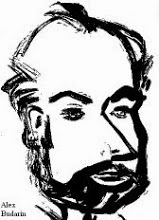
My wife, who is an artist, drew the picture at left in 1996. I had hair on top back then. Now it grows out of my ears and nose instead.
OF ALL THE THINGS I HAVE DONE IN MY LIFE, I am proudest of this blog. I hope someone reads it!
EDUCATION:
Master’s Degree in Sociology;
WORK EXPERIENCE:
Case Worker, Researcher, Teacher, Supervisor, Assistant Manager, Actor, Janitor, Busboy, Day Laborer;
COUNTRIES I HAVE VISITED:
Austria,
England,
France,
Germany,
Switzerland,
Italy,
Slovakia,
Hungary,
Slovenia,
Egypt,
Thailand,
China,
Taiwan,
Japan,
Canada,
Mexico,
Colombia,
Brazil,
Argentina,
Paraguay;
FAMILY: Father from Ukraine, Mother from USA, wife from Colombia, one brother and one sister;
LANGUAGES: English, Spanish and German [although my German is "rusty"];
CITIZENSHIP: USA.
My wife, who is an artist, drew the picture at left in 1996. I had hair on top back then. Now it grows out of my ears and nose instead.
OF ALL THE THINGS I HAVE DONE IN MY LIFE, I am proudest of this blog. I hope someone reads it!
Thursday, August 30, 2007
High Crimes & Misdemeanors
- Illegal Wiretapping [for FOX viewers, that means without the warrants required by existing law]
- Elimination of Habeas Corpus [for anyone they label a “terrorist”]
- Use of Federal Agencies to Promote his Party [as in firing US Attorneys to replace them with loyal Bushies]
- Use of Signing Statements to Subvert the Will of Congress and enforce laws – or not- as he sees fit
- Obstruction of Justice [by refusing to comply with subpoenas]
- Unitary Executive Theory & Practice [under which terms he is the Final Decider for as long as he can make a war last]
- Misrepresentation of Evidence to Wage War [specifically in the case of Iraq]
- Release of Formerly Classified Information for Political Purposes [as in the case of Valerie Plame]
- Refusal to Honor International Conventions & Treaties entered into by the USA [for example, authorization of torture]
- Protecting Members of his Administration who have Lied under Oath [at minimum, Libby & Gonzales]
Alex Budarin
EDUCATION:
Master’s Degree in Sociology;
WORK EXPERIENCE:
Case Worker, Researcher, Teacher, Supervisor, Assistant Manager, Actor, Janitor, Busboy, Day Laborer;
COUNTRIES I HAVE VISITED:
Austria,
England,
France,
Germany,
Switzerland,
Italy,
Slovakia,
Hungary,
Slovenia,
Egypt,
Thailand,
China,
Taiwan,
Japan,
Canada,
Mexico,
Colombia,
Brazil,
Argentina,
Paraguay;
FAMILY: Father from Ukraine, Mother from USA, wife from Colombia, one brother and one sister;
LANGUAGES: English, Spanish and German [although my German is "rusty"];
CITIZENSHIP: USA.
My wife, who is an artist, drew the picture at left in 1996. I had hair on top back then. Now it grows out of my ears and nose instead.
OF ALL THE THINGS I HAVE DONE IN MY LIFE, I am proudest of this blog. I hope someone reads it!
Sunday, August 26, 2007
DNC to oust Florida's delegates

Howard Dean and Alexis Herman would have shown superior leadership in addressing this matter before the Florida legislature changed the primary schedule. Now the reaction of the DNC is borderline incompetence and certainly void of understanding of the concerns of Florida voters. The DNC was never strong enough on keeping corruption out our voting system, or demanding a voting system the people could have confidence. That is why Florida voted to move up its primary. This matter ultimately should be left to the states opposed to a national party that dropped the ball on this issue. Were Dean and Herman sleeping when Florida was debating this schedule change? This further shows the weakness of the Democrats; a lack of unity in addition to strong leadership. The DNC disenfranchising Florida voters may spark the important fringe Democrats that always vote, volunteer and contribute to break away from the Democratic Party.
"Message from Karen Thurman
As Chair of your State Party, I will go before the Rules & Bylaws Committee of the Democratic National Committee (DNC) on Saturday to fight to preserve Florida's full and diverse representation in the presidential primary process.
Under the Rules, the DNC has the authority to slash the delegate voting power of states that hold unauthorized presidential primaries prior to February 5, 2008, essentially making their votes meaningless. Because the Republican-controlled state Legislature moved our state's primary to January 29, 2008, Florida Democrats may be subject to severe penalties.
On Saturday, we will make our case to the DNC. I'm going to fight to have Florida's votes counted, but in reality, I'm only one out of more than four million Florida Democrats. The DNC really needs to hear from people like you.
Can you take just a few moments to tell the DNC why you believe it should make Florida count? I'm going to take your messages - and your voices in spirit - with me to Washington. The meeting is Saturday morning, so get your comments in by Friday at 5 PM.
http://www.fladems.com/standtogether
As you may recall, we've had success in the past when your voice was heard, such as when Democratic legislators read your comments on the floor of the Florida Senate in the heat of the class-size debate in 2006. We succeeded then because of your support, and I have faith that your action now will help make the difference.
You have the power. Tell DNC Chairman Howard Dean and the Rules & Bylaws Committee how important it is that Florida's votes be counted on January 29. I truly believe they will listen.
http://www.fladems.com/standtogether
Florida Democrats must stand together and demand that our votes be counted. In this discussion, there is nothing more important than making sure that Florida Democrats are not disenfranchised.
Our state has seen far too much of this in the past: the 2000 election debacle, eligible voters purged from the voting rolls based on race, Black voters intimidated at the polls, 18,000 votes vanishing because of touch screen machines in 2006, the list goes on and on.
Send a message right now. There's no time to waste.
http://www.fladems.com/standtogether
Thank you for your continued support and dedication.
Sincerely,
Congresswoman Karen L. ThurmanChair, Florida Democratic Party
P.S. Send me your comments right now, and be sure to forward this email to your friends, neighbors and families. Please don't put this off. Thank you again."
Report:
http://www.npr.org/templates/story/story.php?storyId=13950870
Wednesday, August 22, 2007
Concerns for Lucy

The Lucy exhibition has been praised by some as a coup for Texas and denounced by others as the reckless exploitation of one of humanity's most famous ancestors. Renowned paleontologist Richard Leakey even called it a form of prostitution."
Monday, August 20, 2007
Hillary or Obama: that is the question.

I pray Hillary will not focus so heavy on fundraising; running the traditional professional style campaign. An early 2 pronged approached is necessary to win (People & Money). The reality is as a women with high negative points, runs from James Carville’s playbook will not suffice.
Building a true grass roots structure in Florida is essential. A presidential candidate could win more votes locally where it’s needed opposed to big money cost like national TV commercials. The popular vote does not win the presidency. Karl Rove put Bush in the White House by micro targeting and turning out the vote of a small conservative base. He won by thinking small strategically scoring the electoral victories. Polls show as of August 20, 2007 Clinton leads nationally but is behind in Iowa and New Hampshire.
My personal out look is that a national campaign can be won with feet on the ground, a movement if you will. Anthony Brooks’ playbook consists of a two-pronged approach: People and Money or more formally Organization and Fundraising. 1 Chief Campaign Manager and 2 Deputies in charge of each of these functions. Build the organization down from there. Completely separate functions, not as the campaigns are currently formed where all efforts are fundraising until 2 months before election time then a half baked GOTV operation is attempted usually better orchestrated by seasoned local leaders.
A strong organization can trump big money. Picture the Civil Rights Movement which was victorious not via big money but by mobilizing people. I know first hand the Democratic Party has hordes of folk that have signed up to volunteer whom are being under utilized while in addition to being bombarded with hits for donations could be put to work.


